


Ubiquiti GBE i UBB - field performance tests
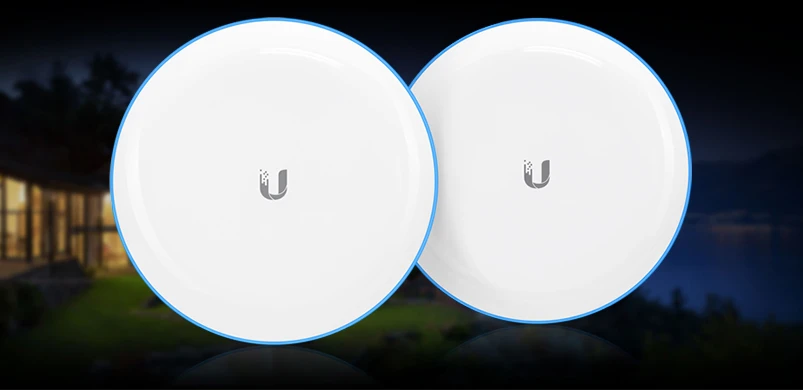
As we already know for some time now, the 5GHz band has been getting more and more crowded every day and it's getting harder and harder to deliver the required capacity to customers. In such a situation the 60GHz frequency comes to our aid! Although the band is designed for short range connections it is very fast! This solution can find its purpose in an urban agglomeration, where in the 5Ghz band we are not able to transfer the required throughput and there is no possibility to make a fiber optic installation.
Ubiquiti 60Ghz PTP (Point-to-Point)
Ubiquiti Inc. presented a whole series of new solutions based on the 60GHz band with a failover option for 5Ghz in case of weather changes (e.g. rainfall). In this article we'll deal with "smaller" products, compared to the airFiber60, i.e. Ubiquiti airMAX GigaBeam and Ubiquiti UniFi Building-to-Building.
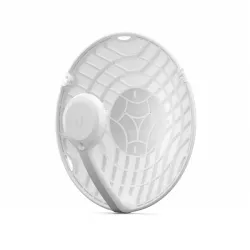
Ubiquiti GigaBeam (GBE)
Ubiquiti GBE is a small 60GHz radio (including antenna) with a 5GHz emergency switching option. It is dedicated for short distances (up to approx. 500 meters) and provides throughput up to 1Gbps. GigaBeam is based on the well-known airMAX protocol and can work in full the full width of the band at 2.16GHz.
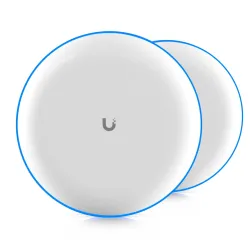
Ubiquiti UniFi Building-to-Building (UBB)
Ubiquiti UniFi UBB is a ready-made PTP bridge using the 802.11ad technology, with a 5GHz (failover) emergency link of course. It is also designed for short distances of up to about 500 meters and can provide throughput up to 1.7Gbps. Building-to-Building is based on the UniFi protocol and is also configured via the UniFi OS Console. It is important to note that the UBB UniFi Bridge, is managed by the UniFi Network Controller version 5.12.0 or later.Test environment
As part of field tests, we decided to check the equipment in the beautiful surroundings of Częstochowa. According to the manufacturer, Ubiquiti Inc., the maximum operating distance of the devices is 500 meters. Therefore, we decided to test the devices at a distance of approximately 350 meters to have some reserve distance. We have similarly tested both the Ubiquiti airMAX GigaBeam and Ubiquiti UniFi Building-to-Building.
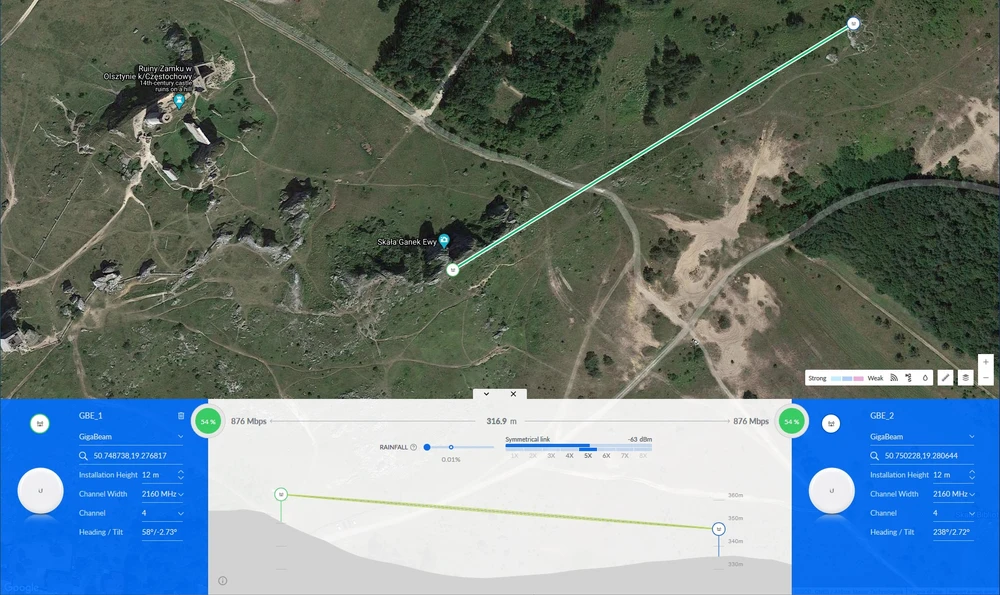
We performed speed tests in two stages:
Network diagram
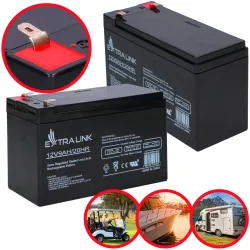
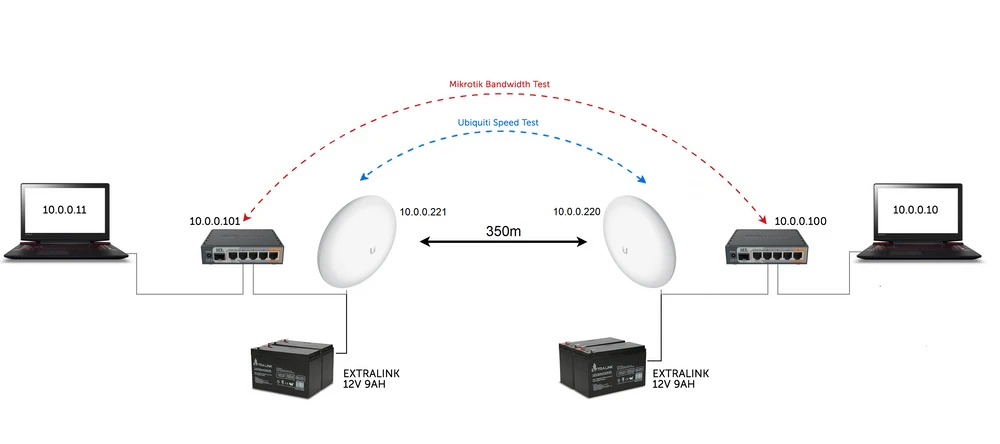
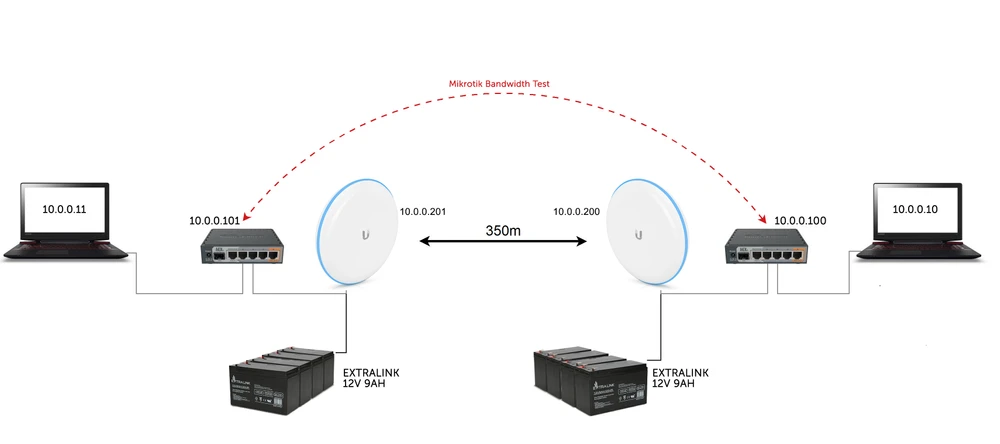
To better illustrate how the various stages of testing went, there is a diagram of our test network below. We were testing in field conditions, therefore we used Extralink 12V 9Ah AGM accumulators. In the case of Ubiquiti Gigabeam, these were two 12V batteries connected in series to get 24V. In the case of Ubiquiti Unifi Building-to-Building, there were as many as 4 batteries, due to the fact that UBB is supplied with 48V (PoE 802.3af).
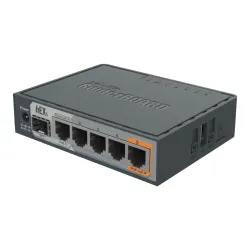
Of course, this time too, we used a very efficient unit for capacity tests - MikroTik hEX S (RB760IGS). MT7621A chipset, 2 880MHz CPU cores, 256MB RAM and PoE out to 57V (Ethernet 5). In short: great hardware for BTest performance testing!
Of course, this time too, we used a very efficient unit for capacity tests - MikroTik hEX S (RB760IGS). MT7621A chipset, 2 880MHz CPU cores, 256MB RAM and PoE out to 57V (Ethernet 5). In short: great hardware for BTest performance testing!
Test network - Ubiquiti Gigabeam
Testing network - UniFi Building-to-Building (UBB)
Ubiquiti configuration
All devices tested have been updated to the latest software. Ubiquiti Gigabeam worked on GBE.V0.11.1 software, while the UniFi UBB on version 2.0.8.42901.
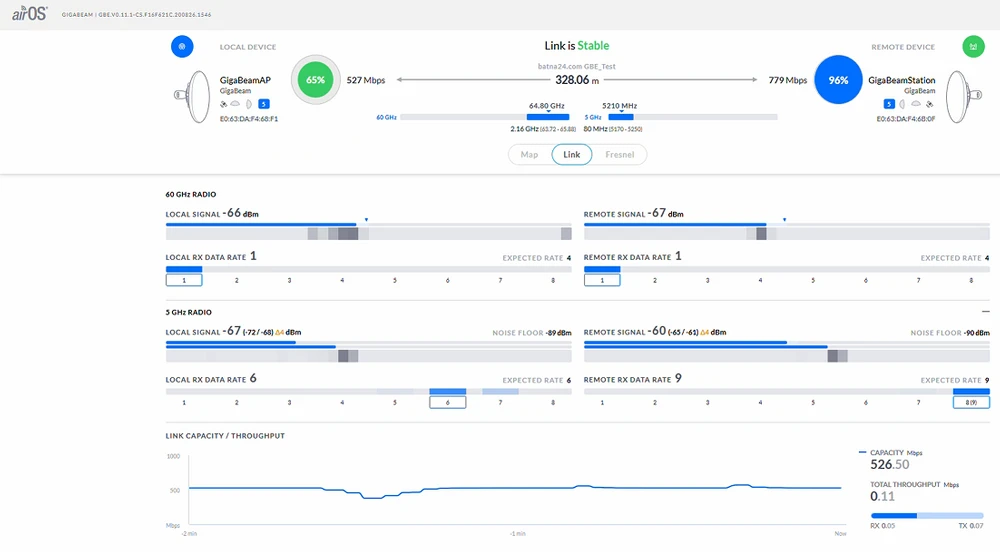
In Ubiquiti Gigabeam, for 60Ghz frequency we set the channel 64800MHz, with channel width 2160MHz. For backup (failover) 5GHz we used 5210MHz channel and 80MHz channel width. With such settings we have set up a stable link over a distance of about 330 meters. For 60GHz we got signal -66dBm and -60dBm, for backup link (5GHz).
In Ubiquiti Gigabeam, for 60Ghz frequency we set the channel 64800MHz, with channel width 2160MHz. For backup (failover) 5GHz we used 5210MHz channel and 80MHz channel width. With such settings we have set up a stable link over a distance of about 330 meters. For 60GHz we got signal -66dBm and -60dBm, for backup link (5GHz).
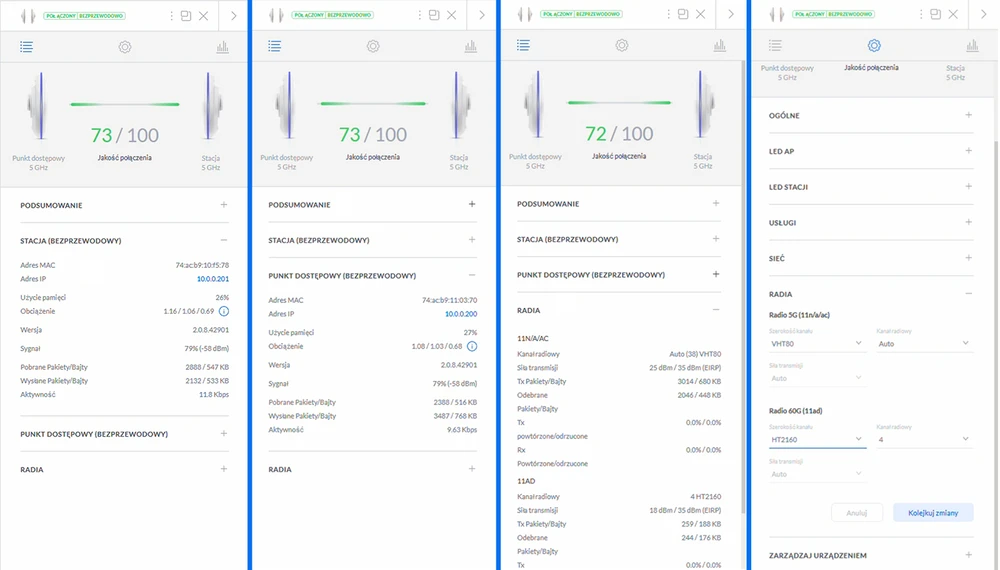
Similarly, the configuration of Ubiquiti UniFi UBB went very well. For 60GHz band we set 4HT2160 channel, while for 5GHz band we left Auto option. The devices themselves chose channel 38 at 80MHz (VHT80) and managed to get -58dBm signal. It's also worth remembering that both UniFi Building-to-Building and Gigabeam have small dishes, so they have to be pre-positioned, which takes some time. It is also noteworthy that the UniFi UBB has a led ring, which indicates the quality of the connection with different colors.
GBE performance
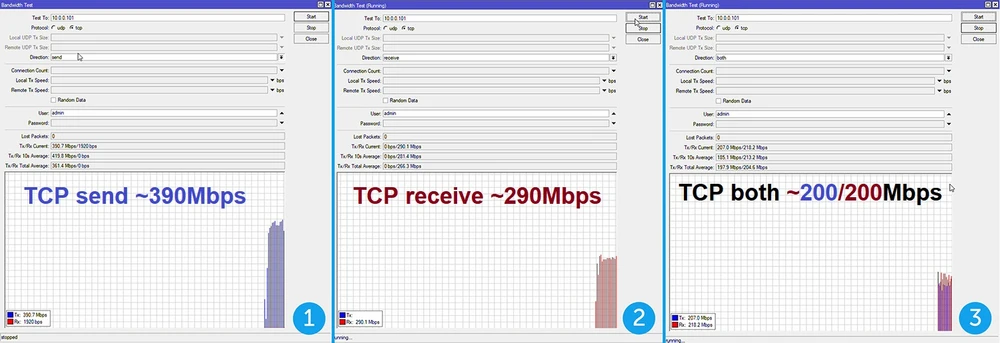
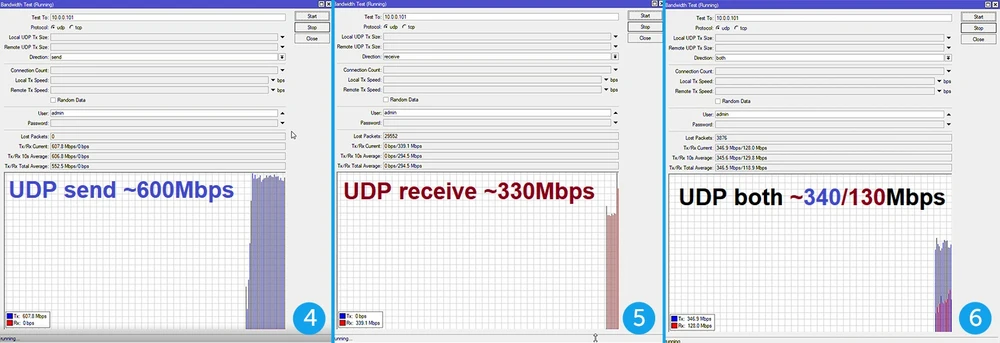
As I mentioned earlier, we did the Ubiquiti Gigabeam performance tests in two stages. In the first stage, using the built-in Ubiquiti SpeedTest (Receive, Transmit, Duplex; duration 30 seconds); second stage, using MikroTik Bandwidth Test (TCP and UDP protocol).
Ubiquiti Speedtest - Gigabeam

MikroTik Bandwidth Test - Gigabeam (TCP)
MikroTik Bandwidth Test - Gigabeam (UDP)
Performance of UBB
In the case of Ubiquiti UniFi Buiding-to-Building we only tested using Mikrotik hEX S (RB760IGS) and its built-in Bandwidth Test tool. We focused on tests in the TCP protocol, as its use guarantees us reliable data delivery. And as we test the UniFi family, we want all packets to arrive correctly.
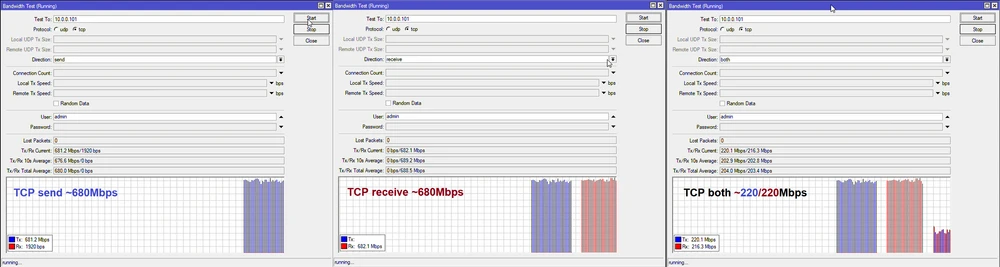
Summary and conclusions
We have to admit that the whole series of new products 60Ghz from Ubiquiti Inc. works great! We have already had the opportunity to test airFiber60 (AF60), which made a really good impression. The same goes for both Ubiquiti airMAX Gigabeam (GBE) and Ubiquiti UniFi Building-to-Building (UBB). The devices will work equally well. Although they are designed for much smaller distances, as we can connect them up to a distance of 500 meters, the results are still very satisfactory. 600Mbps with such small devices, this is sufficient capacity to provide our customers with high quality service, even when our main connection fails. Also noteworthy is the fact that UBB is a typical plug-and-play solution. We configure it via the UniFi controller, and thanks to that the configuration process is trivially simple. In essence, the whole range of Ubiquiti Inc. products, working at 60GHz with failover option at 5GHz deserves our recognition. Of course, the LR (GBE-LR and AF60-LR) series is just as interesting, so we invite you to take another test of Ubiquiti Inc. solutions.
. We invite you to our FORUM, where you can share your insights with the entire community of Ubiquiti users and more!
. We invite you to our FORUM, where you can share your insights with the entire community of Ubiquiti users and more!
Author: Leszek Błaszczyk