


Ubiquiti airFiber60 | AF60 - field performance test
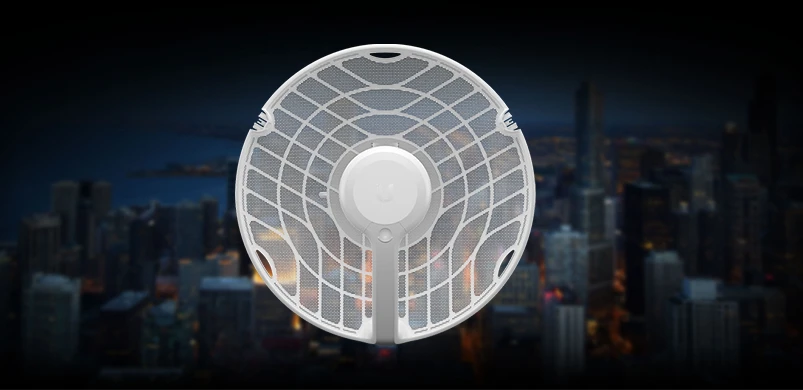
At the beginning of 2020 Ubiquiti Inc. presented a new range of wireless solutions operating at 60GHz. Additionally, the devices were equipped with a radio module operating at 5GHz frequency, which acts as a backup link (failover). New solutions have appeared in each of the three product lines:
- UniFi: Bulding-to-Building (UBB)
- AirMax: GigaBeam (GBE)
- AirFiber: airFiber 60 (AF60)
Operating at 60 GHz
Although devices operating at 60GHz are extremely efficient, it must be pointed out that they are very vulnerable and sensitive to changing weather conditions - the higher the frequency, the greater the attenuation. New radiolines from Ubiquiti Inc. are equipped with typical directional antennas and thanks to that we can set up a very precise link. The second emergency radio working at 5GHz frequency deserves special attention. This provides us with a backup link in a situation when e.g. weather conditions lead to disconnection of the 60GHz link. Although the transmission quality decreases the link still remains stable.
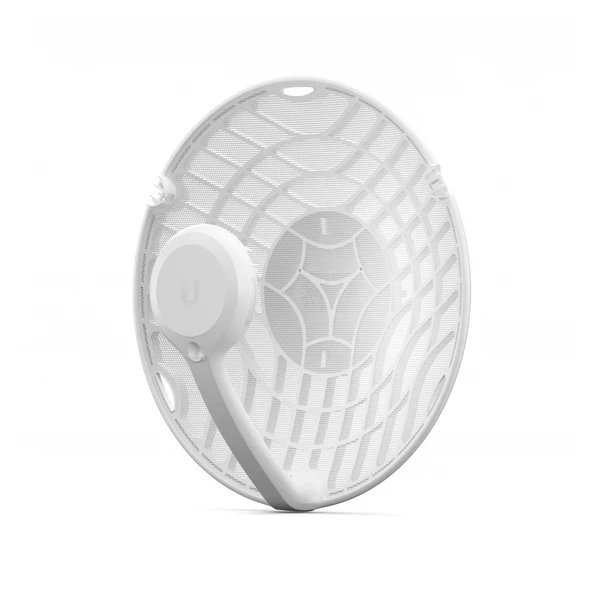
Ubiquiti AirFiber 60 (AF60)
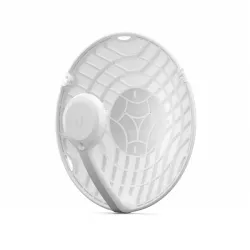
The new Ubiquiti AF60 is a typical point-to-point solution that is dedicated to work at a maximum distance of 2km. As I mentioned earlier the radio line has been equipped with two radio modules: 60GHz with 38dBi gain and 5GHz with 11dBi gain. The maximum, total power of TX transmission (5/60 GHz) is 25dBm, and if we take into account the channel width 2160MHz for 60GHz, then we can achieve a throughput of 1.8 Gb/s. Additionally, the AF60 is also equipped with a GPS module. Of course we decided (www.batna24.com) to check the arFiber60's capabilities in the field.
Test environment
The performance tests were as reliable as possible, we decided to conduct field tests. The link was set up at a distance of 1.5km in the beautiful surroundings of Częstochowa.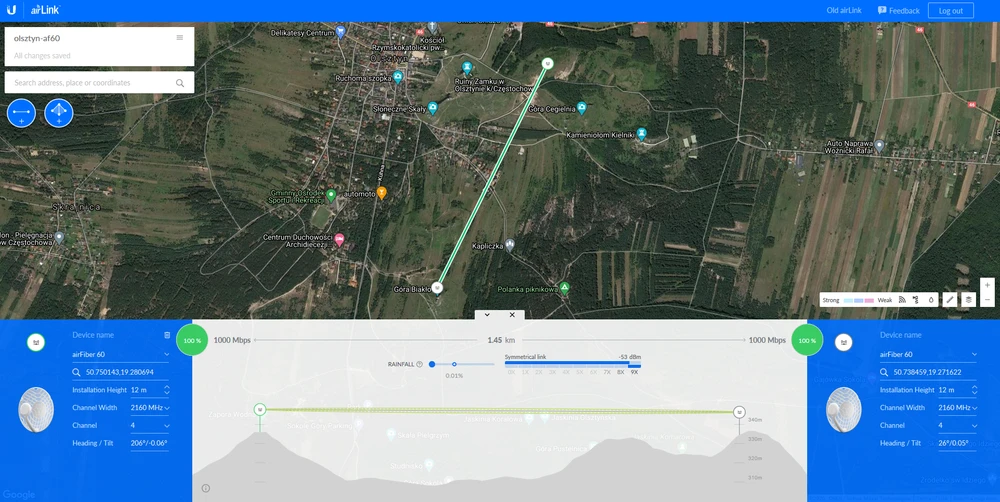
Test network diagram
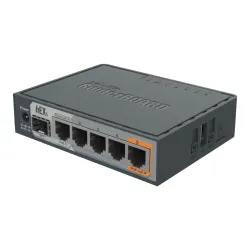
In order to best illustrate how we performed the bandwidth tests of the Ubiquiti arFiber 60 Ghz, below is a diagram of the network we set up in the field conditions. In the tests we used the following devices: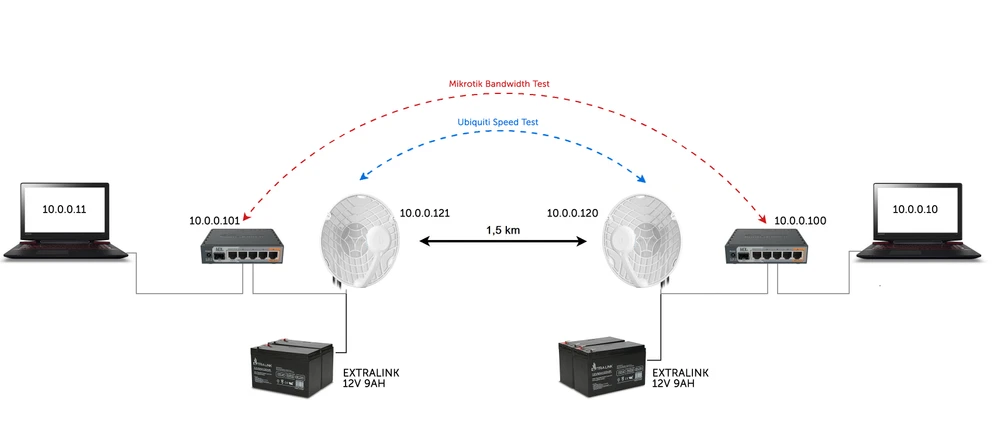
Configuration of airFiber60
Before we go to performance testing, it is worth knowing how the devices were configured. And what's most important, at first we updated the firmware to GP.V 2.3.1  We then set the Access Point with SSID: "batna24.com AF60_Test", we selected a country Poland, we set the working channel for 60GHz to 64800MHz, with a channel width of 2160MHz. For the backup 5GHz link, we set the channel to 5120MHz (outside DFS) with a width of 80MHz. Output Power was set to 25dBm.
We then set the Access Point with SSID: "batna24.com AF60_Test", we selected a country Poland, we set the working channel for 60GHz to 64800MHz, with a channel width of 2160MHz. For the backup 5GHz link, we set the channel to 5120MHz (outside DFS) with a width of 80MHz. Output Power was set to 25dBm.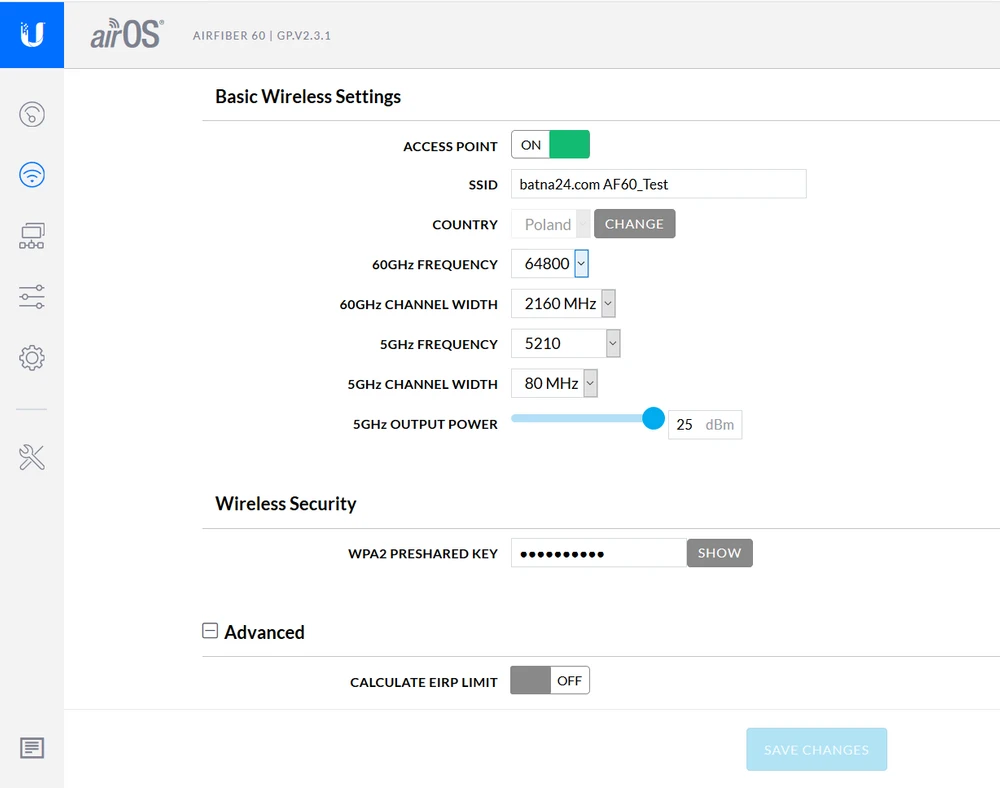
Signal strength - antenna jamming
Before we started testing the performance of Ubiquiti AirFiber 60, the antennas had to be precisely set up and aligned. Due to the high frequency, which was as high as 64.80GHz, it seemed that it would be a very laborious process. However, to our surprise we managed to set a signal of -65dBm at 60GHz, and the distance was almost 1.5km. It is also worth noting that we were setting the antennas up in the field, where we didn't have a stable mounting point. And all this can be seen in our video.
Performance of Ubiquiti airFiber60
We conducted speed tests in two stages:
- Built-in mechanism Ubiquiti SpeedTest - Transmit, Receive, Duplex (Duration = 30 seconds)
- MikroTik Bandwidth Test
- Protocol TCP - receive, send, both
- Protocol UDP - receive, send, both
Ubiquiti Speed Test
Transmit 1002,14Mbps (1Gbps!)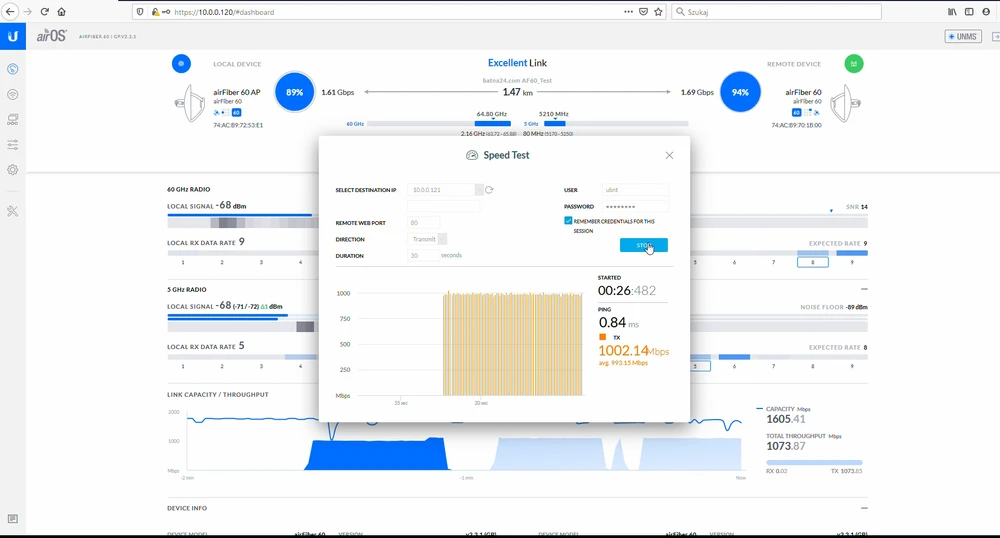
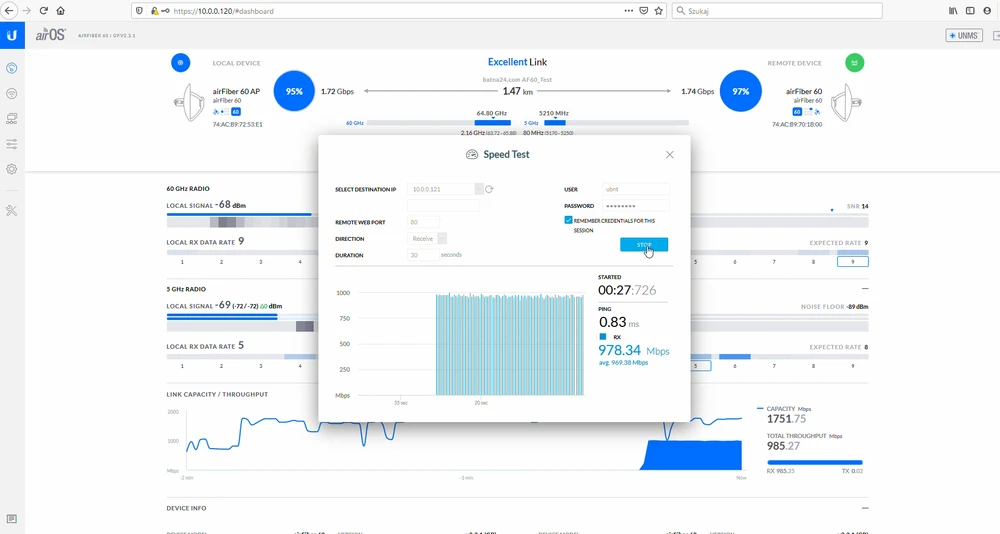
Receive 978.34Mbps
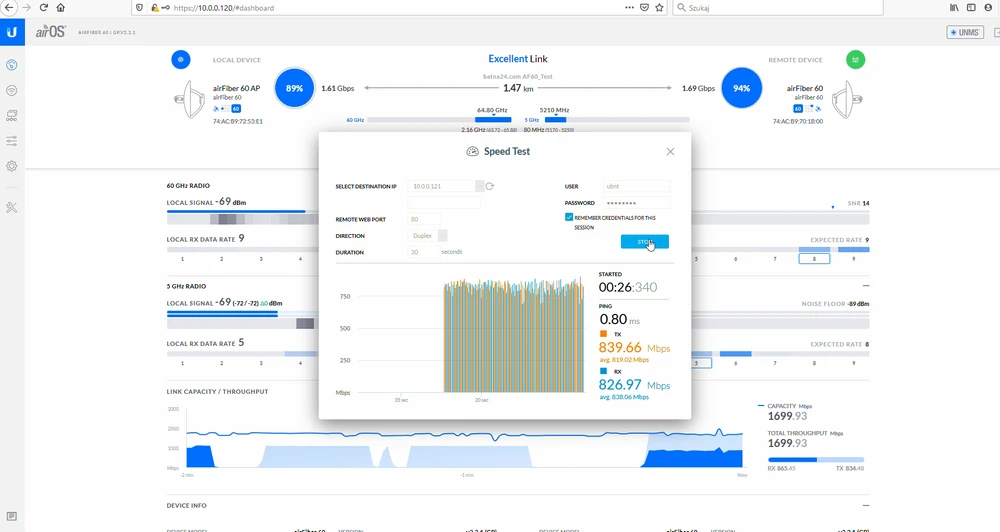
Duplex 839.66Mbps / 826.97Mbps
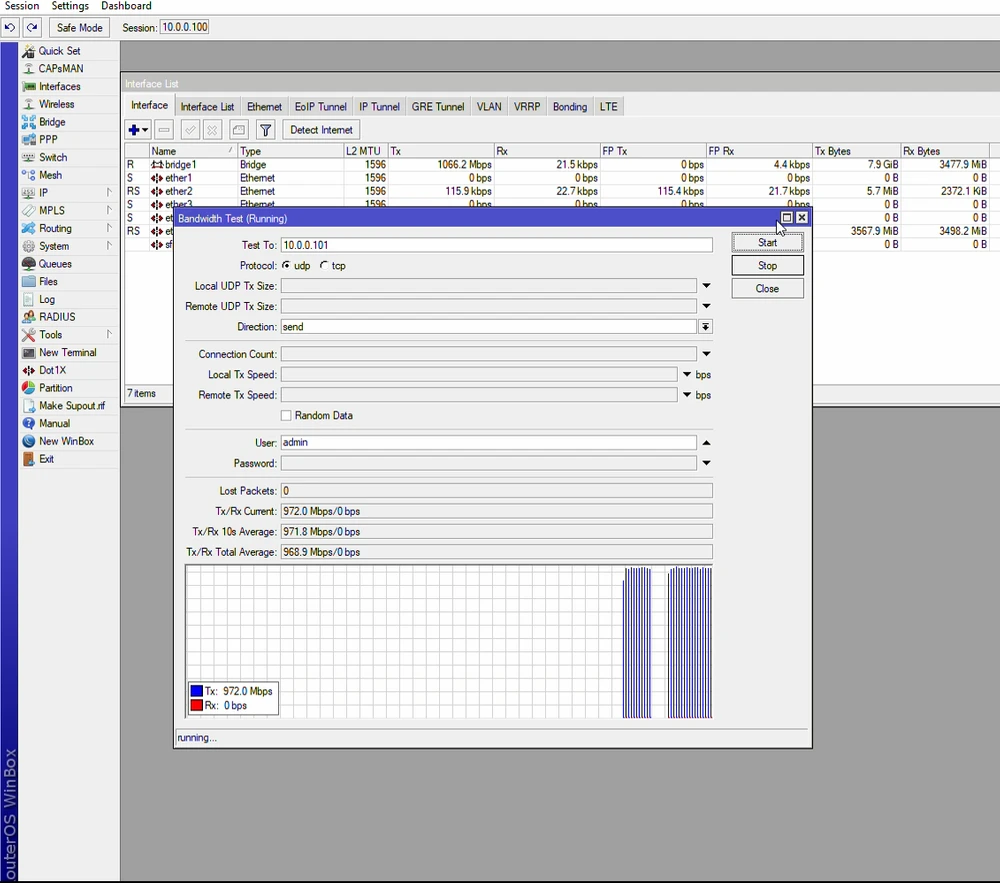
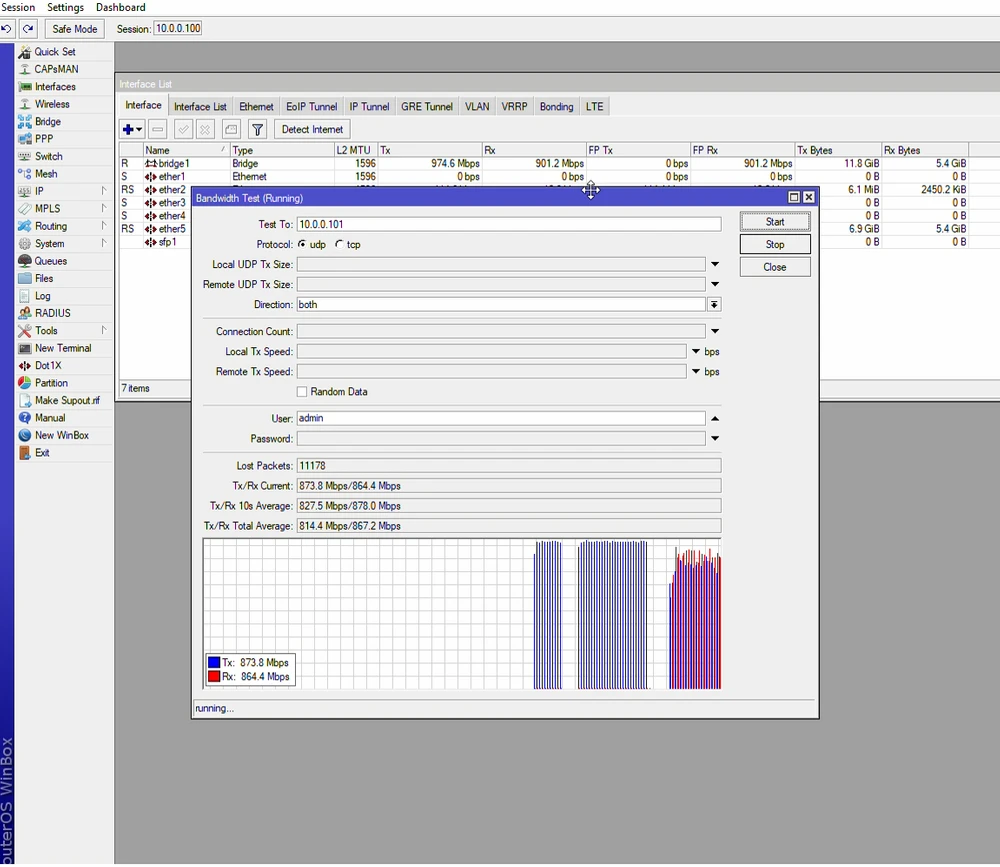
Mikrotik Bandwith Test - UDP
Receive 971.4 Mbps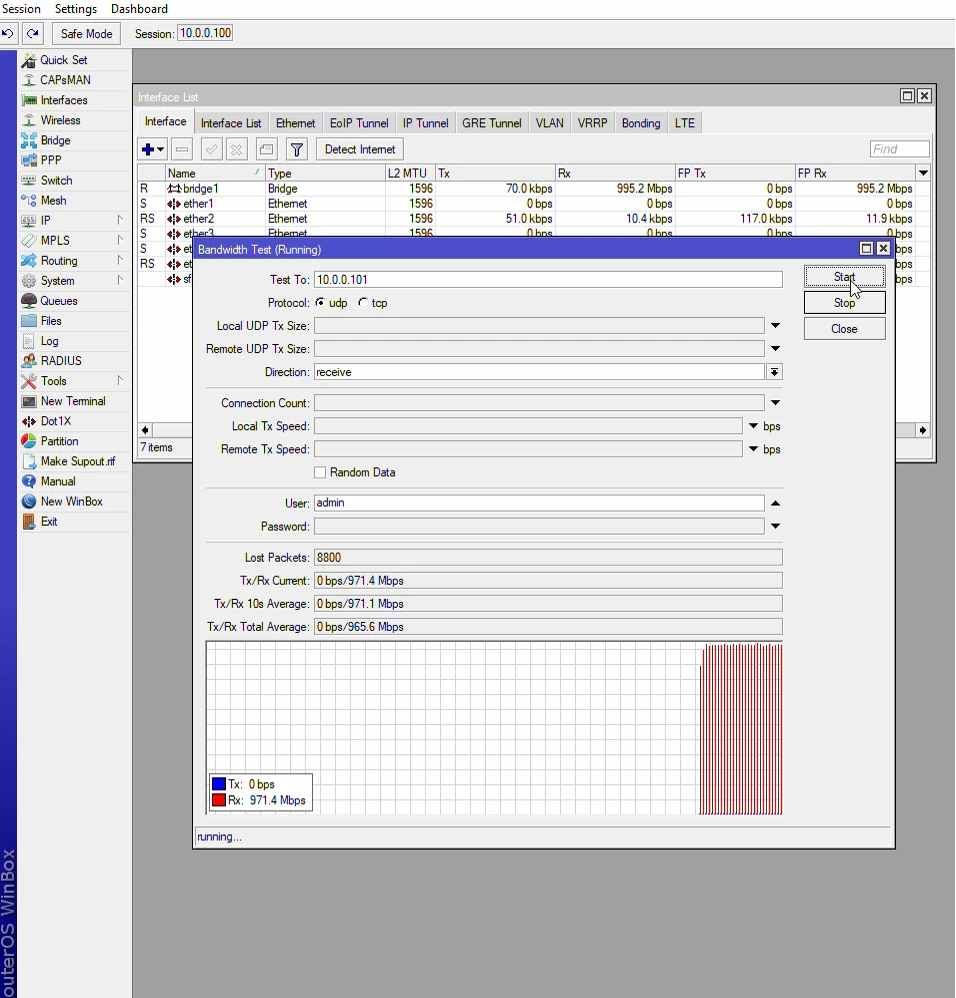
Send 972Mbps
Both 873,8Mbps / 864,4Mbps
Summary and conclusions
In summary, the results of the capacity tests in the field are truly impressive. Ubiquiti Inc. has stood up to the challenge and found itself well in the 60GHz product line. At 1.5km it managed to achieve a throughput of about 1.8Gbps (both ways). Additionally, the failover option on 5GHz is unique in solutions working in such high frequency (60GHz). As you already know, at higher frequencies the attenuation gets higher as well. AirFiber60 was tested in a sunny, rainless weather, and yet the time is approaching when both rain and snowfall will become the usual. Therefore, it is worth having a backup link (5GHz), which will maintain the stability of our link, and in the 5GHz band we still managed to send over 400Mbps! In summary, the Ubiquiti airFiber60 is a device worth recommending! It is a backup link for fiber optic solutions in urban agglomerations, where it is not possible to create a fiber optic link even for just 1.5 - 2km. AF60 is also a great solution for ISPs who want to provide a very stable link for business customers. Bravo Ubiquiti!!!
Author: Leszek Błaszczyk