


Ubiquiti LTU | part 2 | professional field tests
- A word of introduction
- Packet efficiency above all else!
- Ubiquiti LTU - long distance test
- 2km test results
- 5km test results
- Ubiquiti LTU - Results 30MHz 2.1-BETA4
- Ubiquiti LTU - Results 30MHz 2.1-BETA5
- Ubiquiti LTU - 50MHz 2.1-BETA4 results
- Ubiquiti LTU - 50MHz 2.1-BETA5 results
- Version 2.1.0-BETA5
- Conclusions
- Summary
A word of introduction
Packet efficiency above all else!
- 21.2bps per Hz (spectral efficiency)
- over 2 million packets per second
- 4096QAM modulation
Ubiquiti LTU - long distance test
Stress test assumptions for LTU:
- CPE end in a LoS range (client cpe) of over 4.5km with a minimum modulation of 64QAM
- Minimum CPE performance with 20MHz channel width at 64QAM Dowload 32Mbps/Upload 7Mbps
- Sector capacity at a 20MHz channel width with 120Mbps/24Mbps minimum
- Measurement of CPE and "sector" performance according to EtherSAM standards (asymmetric traffic) for traffic with IMIX characteristics (Internet MIX according to IETF RFC 6985 "IMIX Genome: Specification of Variable Packet Sizes for Additional Testing") according to parameters presented in the table below.
- The distribution of channels on sectors (4x90 degrees) with no spacing in frequencies. That is, sectors A and C at a center frequency of 5700MHz, and sectors B and D at a center frequency of 5680MHz.
- Tests were performed in the L3 layer
- Packet loss at the level of 0,03%.
- Maximum packet time 50ms
- Maximum packet jitter 40ms
- Maximum instantaneous decrease of preset (minimum) speed to 95%.
- EtherSAM test duration 2 hours
Hardware used for testing
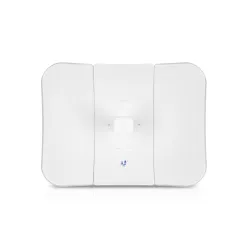
- Ubiquiti LTU Rocket
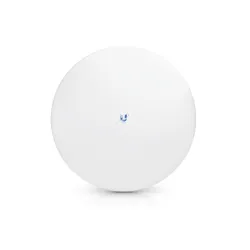
- Ubiquiti LTU Pro (for tests > 4.5km)
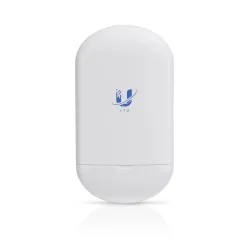
- Ubiquiti LTU Lite (for tests < 2km)
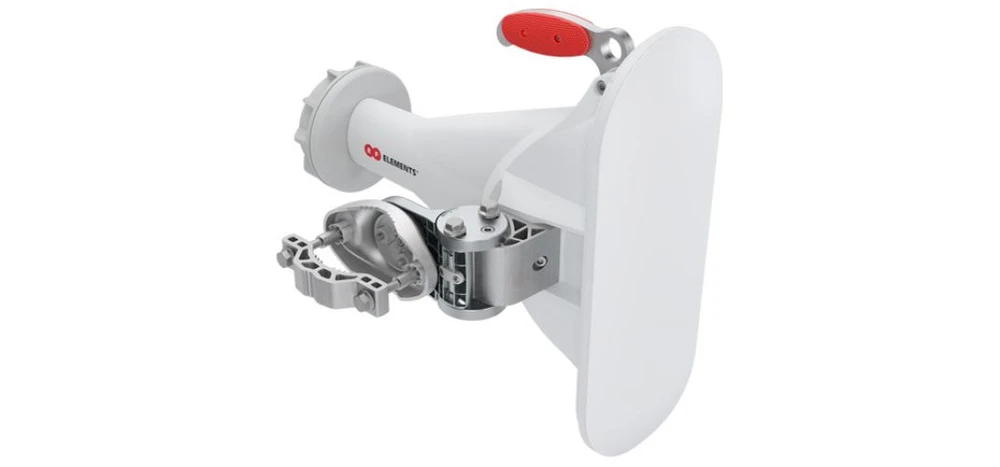
- RF Elements HG3-TP-A90antenna
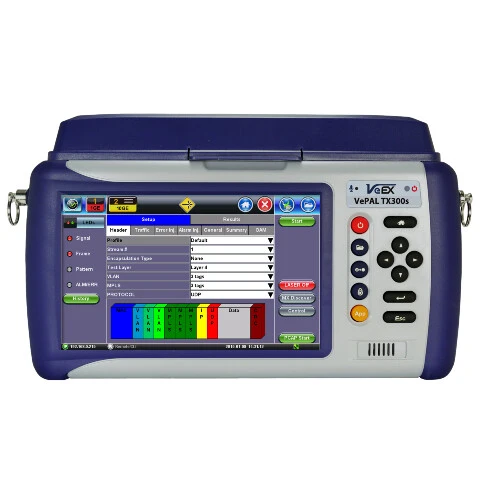
- VeeEx VePAL TX300S meter with software version 3.5.13 for platform and 3.5.7 for module
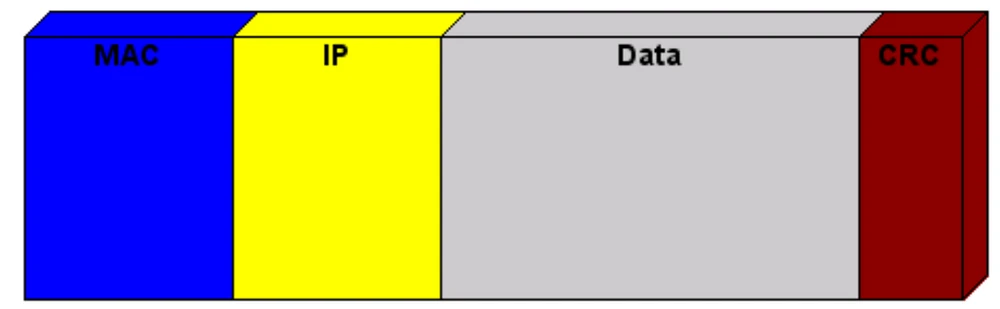
The structure of packets used in the test
No. | Bundle length [B]. | Number of packets (ratio) | Number of packets for traffic (D/U) 32Mbps/7Mbps | Number of packets for traffic (D/U) 120Mbps/24Mbps | |
1 | 68 | 7 | D: 11507 ppsU | D: 43151 ppsU | |
2 | 595 | 4 | |||
3 | 1518 | 1 | |||
Total one set of packets | 2181 bytes | 12 packages |
2km test results
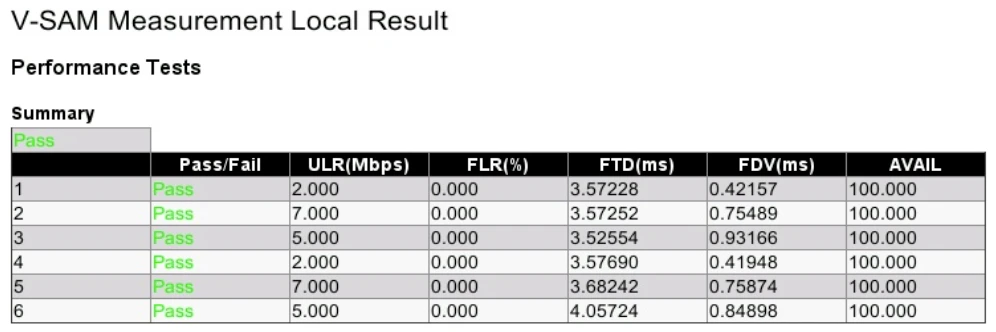
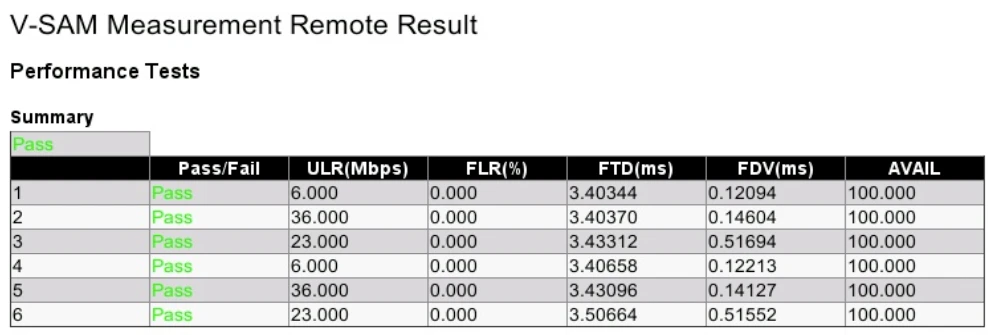
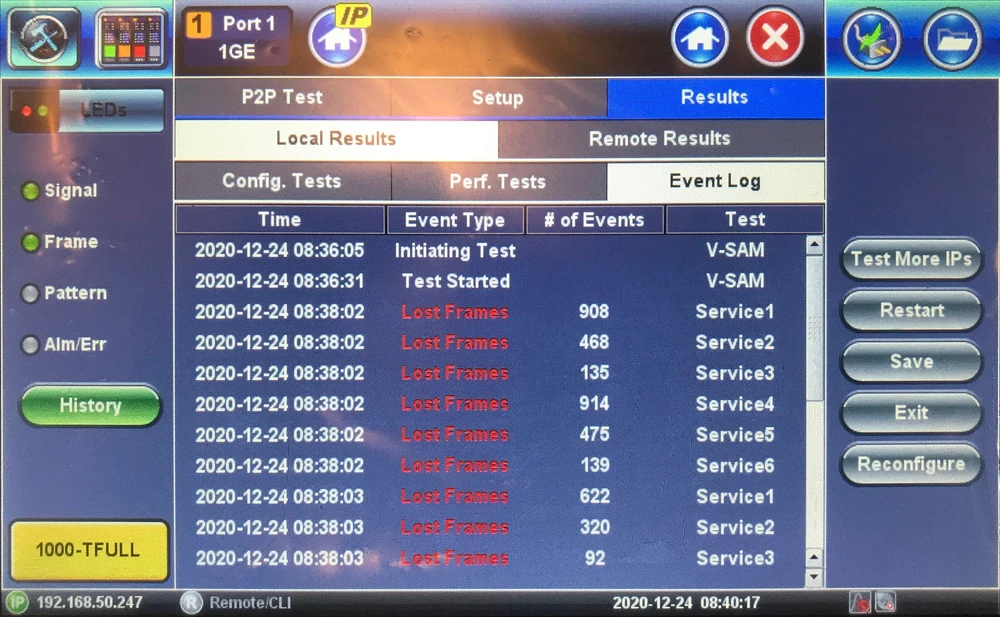
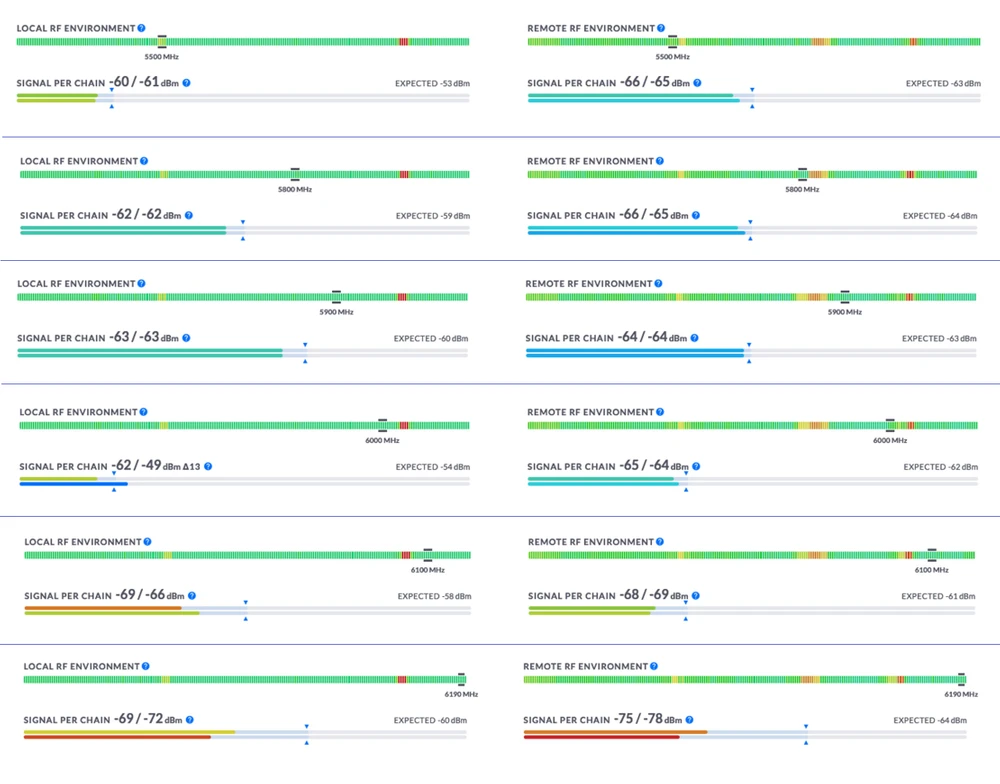
Test results for one CPE (LTU Pro) at a distance of about 2km and a frequency of 6100MHz. The height of the CPE is about 5m above sea level, LoS.
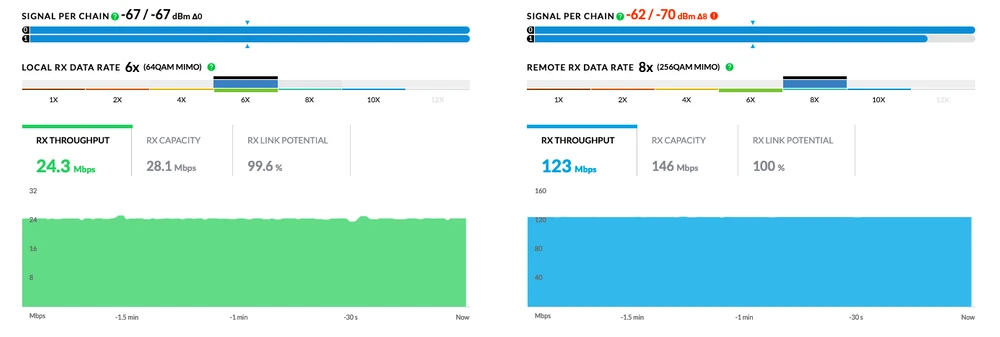
"Local Results" -> uploading from CPE
"Remote Results" -> downloading to CPE.
Network traffic characteristics used for measuring network device performance described in RFC6985 as Internet Mix (IMIX) or other characteristics specified in the manufacturer's documentation.

5km test results
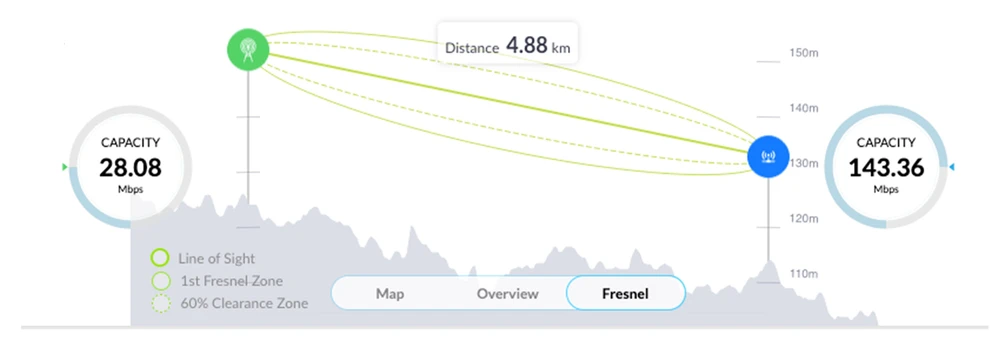
Distance and Fresnel Zone
Ubiquiti LTU throughput test results
As I mentioned earlier, we ran the tests for different software versions, different channel widths, and with a variable"Performance Boost" parameter. Below, the results from the obtained Download and Upload speeds.Distance | 20MHz | 30MHz | 40MHz | 50MHz | ||||||||||||
2.1-BETA4 | 2.1-BETA5 | 2.1-BETA4 | 2.1-BETA5 | 2.1-BETA4 | 2.1-BETA5 | 2.1-BETA4 | 2.1-BETA5 | |||||||||
Performance Boost | OFF | ON | OFF | ON | OFF | ON | OFF | ON | OFF | ON | OFF | ON | OFF | ON | OFF | ON |
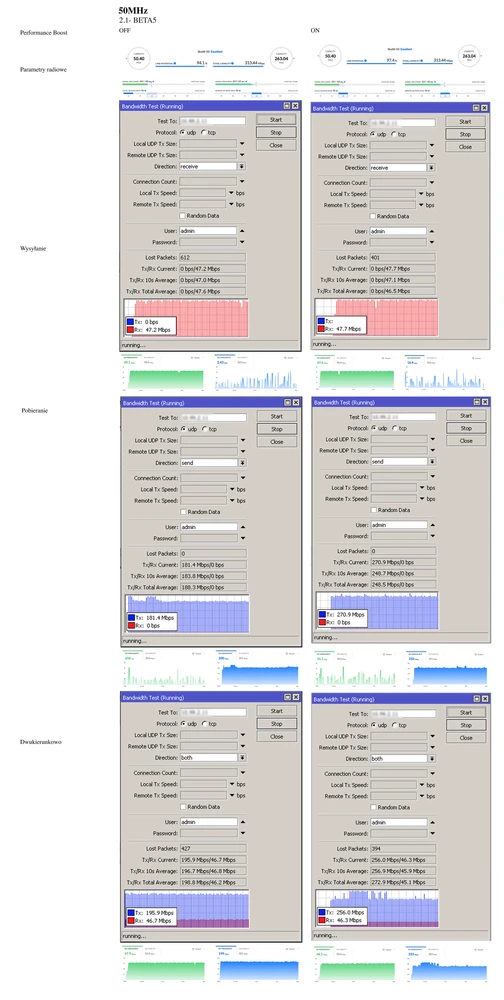
Download [Mbps] | 134.7 | 137.8 | 137.2 | 137.9 | 183.0 | 204.8 | 183.5 | 205.4 | 187.1 | 268.5 | 181.8 | 270.2 | 211.3 | 246.8 | 188.3 | 248.5 |
Upload [Mbps] | 25.2 | 26.3 | 26.4 | 25.7 | 42.0 | 41.8 | 42.0 | 40.9 | 55.7 | 54.7 | 55.8 | 54.6 | 48.1 | 47.3 | 47.6 | 46.5 |
Duplex | 133.9 | 135.2 | 136.5 | 135.3 | 183.8 | 203.1 | 180.5 | 204.2 | 186.6 | 267.7 | 179.4 | 264.9 | 209.1 | 228.7 | 198.8 | 272.9 |
Based on the above results, the conclusions are almost self-evident. The results for 50 MHz are surprisingly low, compared to those for 40 MHz! This is due to lower modulations that the devices have negotiated for this channel width, so it is not recommended to set large channel widths for distant links, unless, of course, the device works as a radio link.
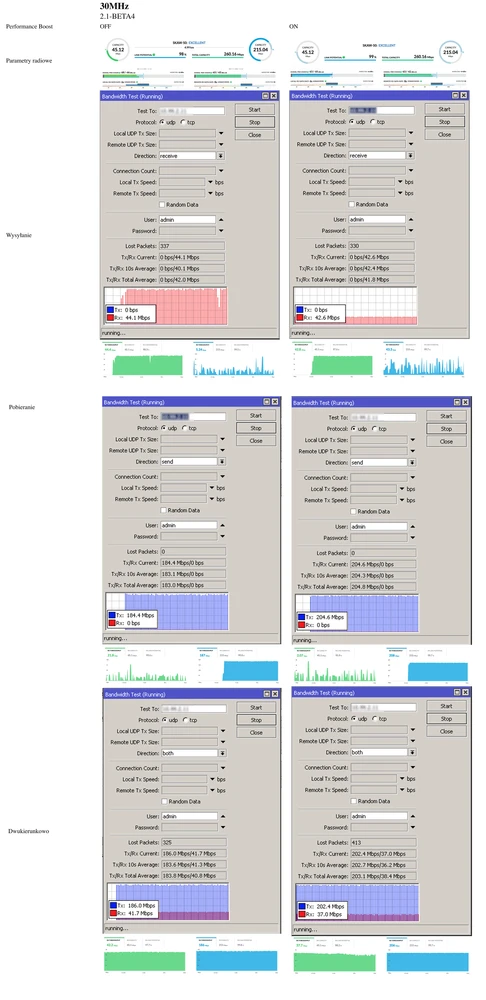
The most optimal is to use 30MHz and we strongly recommend using this channel width. It's definitely a compromise between the effective range and the total capacity of a given sector (transmitter).
Below we present the obtained results. Let's focus only on the tests in the 30 and 50MHz channel widths, since we care about them the most.
Ubiquiti LTU - Results 30MHz 2.1-BETA4
Ubiquiti LTU - Results 30MHz 2.1-BETA5
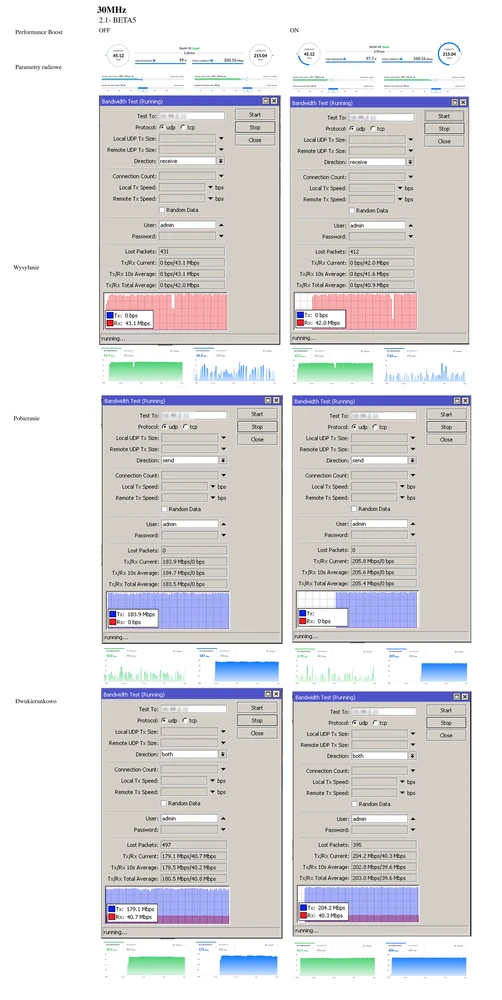
Ubiquiti LTU - 50MHz 2.1-BETA4 results
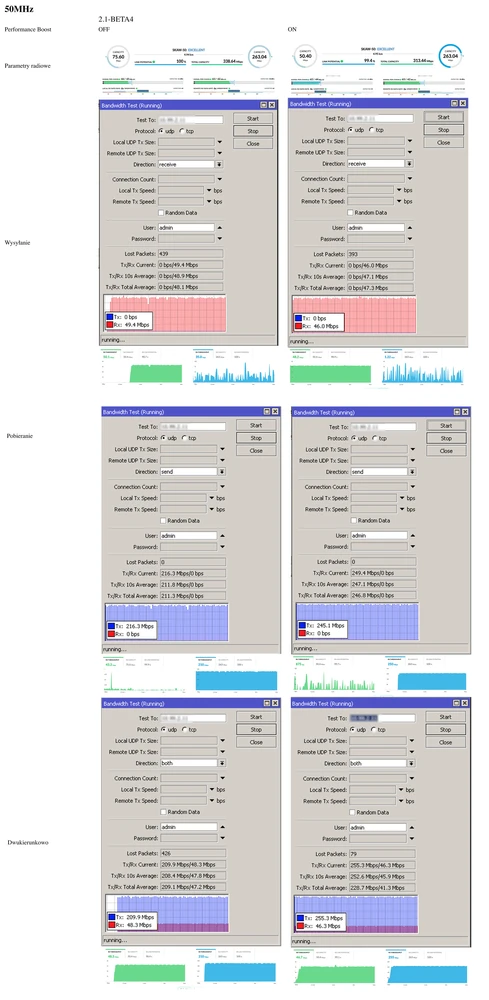
Ubiquiti LTU - 50MHz 2.1-BETA5 results
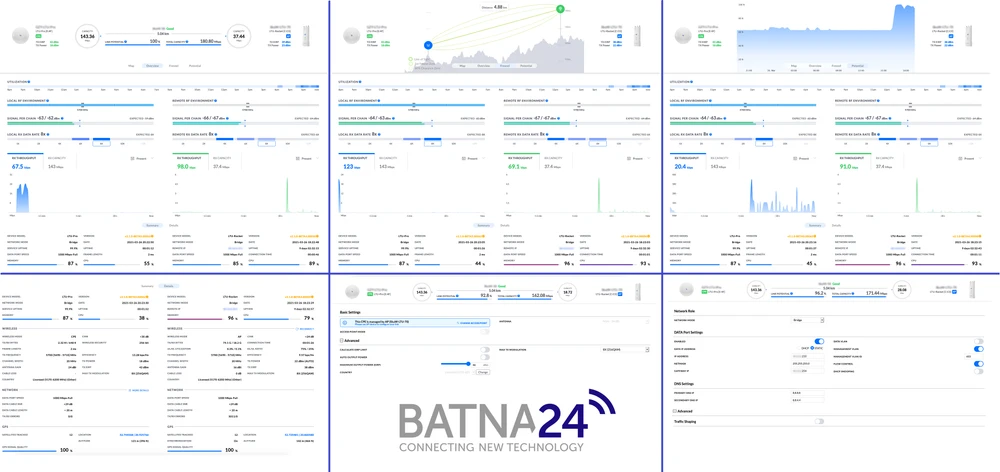
Version 2.1.0-BETA5
Conclusions
2. Enabling the "Performance Boost" function results in increased throughput (maximum band saturation values), at the expense of the number of CPEs the base station can support.
3. Until software versions 2.0.7 and 2.1-BETA4 (inclusive) the split frequency function did not cause any increase in throughput
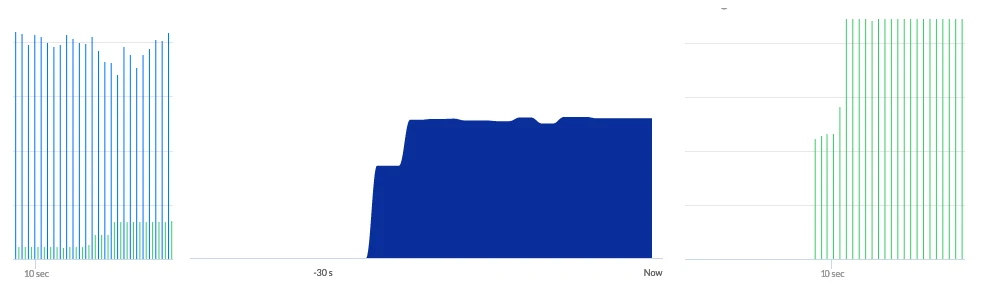
4. Any client CPE that is not used for a longer period of time (sometimes after only 2 minutes) goes to sleep. In the case of download/upload on software up to 2.0.7 and 2.1-BETA4 (inclusive), with full available bandwidth, this caused a stair-stepping effect and of course also involved an increase in modulation. This effect caused the dormant CPE to lose packets at the very beginning (due to buffering and error correction, this is not visible without advanced meters). Software 2.1-BETA5 significantly improves this unfavorable effect and then the problem is no longer troublesome. Tests with the CPE "awake" showed no packet loss.
Summary
One thing is certain. The Ubiquiti LTU series is distinguished by very high packet throughput! And the RoadMap of new features itself makes us optimistic that there will be further changes soon (in future versions of the software), which will increase throughput and operation in nLoS installations. Add to that strong encryption of wireless transmission and the "Performance Boost" mode and we get a very efficient solution that will work in all conditions. And above all, Ubiquiti LTU network devices provide customers with a stable service from the top shelf.
Authors:
Wojciech Repinski
Leszek Błaszczyk