



MikroTik hAP ac3 LTE6 - Performance test
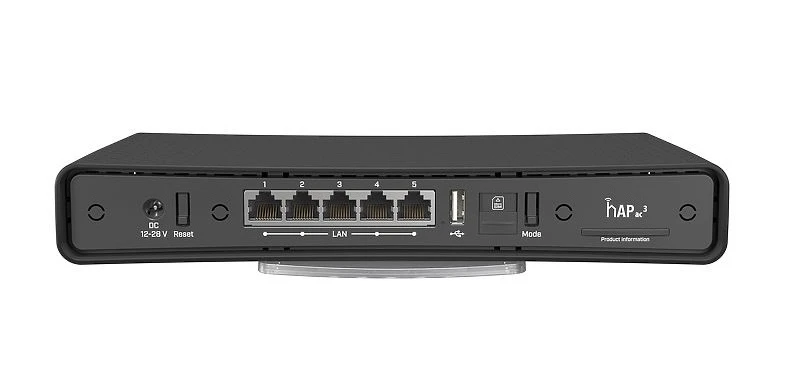

Microtik's most important reason for success is perhaps the original RouterOS operating system, which is capable of solving many tasks remotely away from home. At the same time, the company offers not only a wide range of its own hardware at different levels, but also several license options for a separate operating system that can be run on other compatible hardware or virtual machine. Note that RouterOS has a closed code. Thus, despite the flexibility, it is impossible to exceed the limits provided by the developer on your own. In this material, we will explore the capabilities of MikroTik hAP ac3 LTE6 - a dual-band wireless router with a category 6 LTE modem installed.
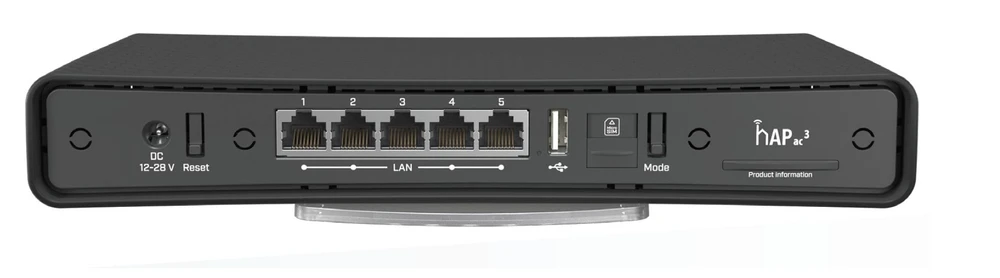
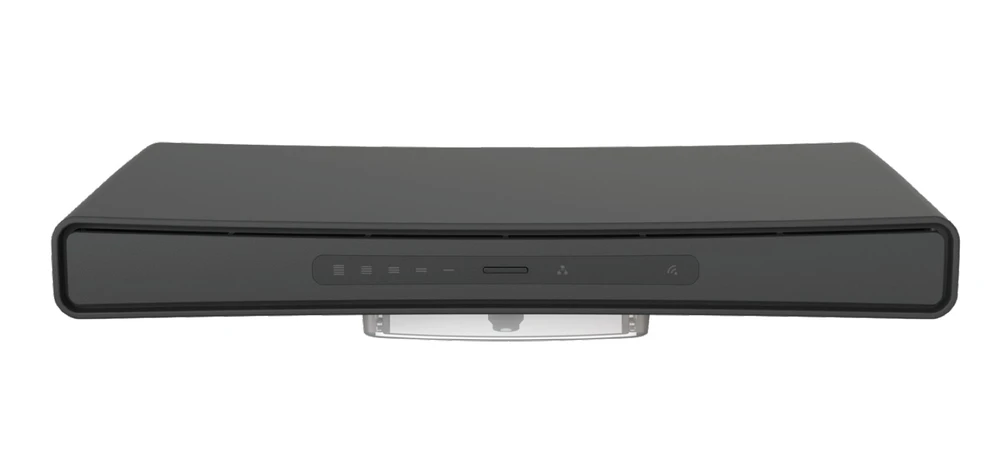
Equipment specification
In addition to the standard power supply via a 24 V DC network adapter, the router can also be powered via a Passive PoE port.
Other hardware functions include the 'Mode' button, to which any script can be assigned. A custom LED can also be assigned to this function. Another interesting feature is the ability to program the power off of the USB port, which can be especially useful when restarting mobile modems. You can also change CPU frequency from 716 MHz to 896 MHz.
The device can operate wirelessly in the following configurations:
RouterOS
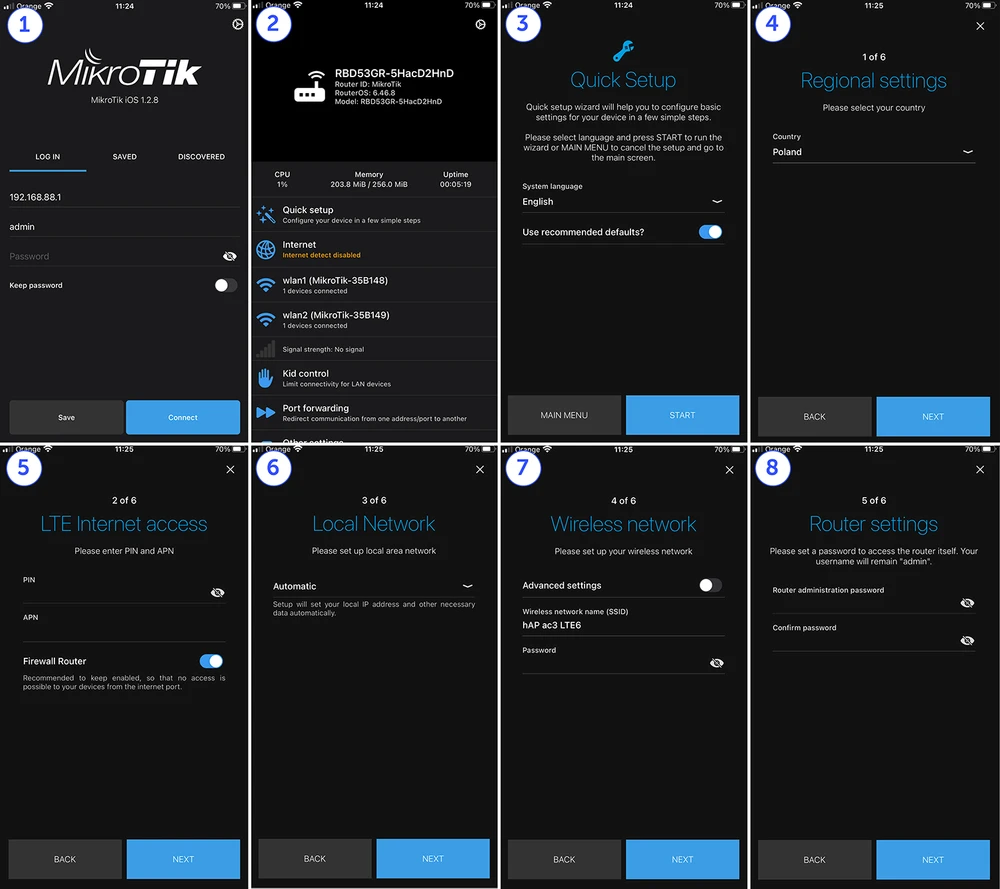
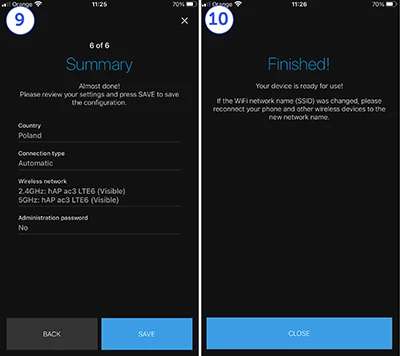
Recently, MikroTik has also made their mobile application available with which you can configure their devices. This is undoubtedly a strong asset for novice users. Prepared wizard allows to configure most of the popular settings. The application contains similar sections to Winbox, although working on the screen of a mobile device is much less convenient than on a computer of course. The company tried to implement more functions in a simplified format, but not everything turned out to be convenient and intuitive.
Performance test MicroTik hAP ac3 LTE6
According to the manufacturer, with basic firewall configuration MikroTik hAP ac3 has a performance for 1518 bytes packets of 1.9Gbps. Of course, for smaller packets of 65 bytes the performance is lower and oscillates at 112-912Mbps.
The IPSEC performance oscillates around 400Mbps for 1400 bytes packets.
The manufacturer has equipped the device with a powerful category 6 LTE modem with download speeds up to 300Mbps and upload speeds up to 50Mbps, with band aggregation options.
Modem parameters
| MIMO | MIMO 2x2 |
| 2G Category | Class 12 |
| 3G Category | R7: Downlink 21MbpsUplink 5.76Mbps R8: Downlink 42.2Mbps Uplink 5.76Mbps |
| 3G Bands | B1 - 2100MHz B2 - 1900MHz B5 - 850MHz B8 - 900MHz |
| LTE Category | 6 Downlink 300Mbps Uplink 50Mbps |
| Carrier Aggregation | 2xCA |
| LTE FDD bands | B1 - 2100MHz B2 - 1900MHz B3 - 1800MHz B7 - 2600MHz B8 - 900MHz B20 - 800MHz B5 - 850MHz B12 - 700MHz B17 - 700MHz B25 - 1900MHz B26 - 850MHz |
| LTE TDD bands | B38 - 2600MHz B40 - 2300MHz B39 - 1900MHz B41n - 2500MHz |
| WCDMA bands | No date |
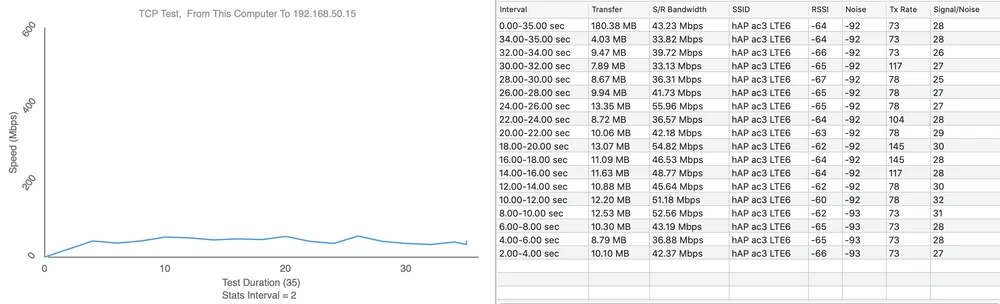
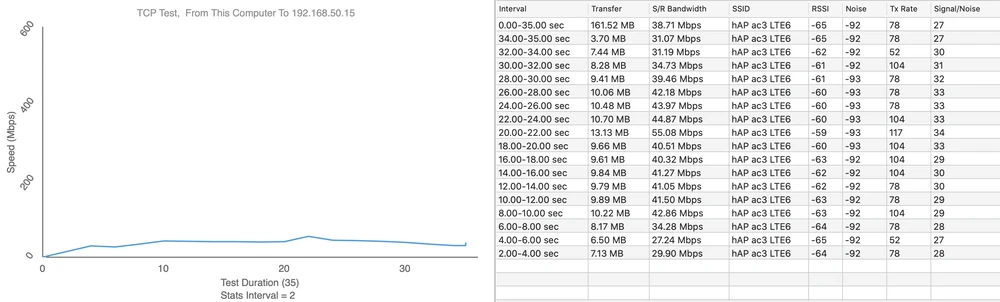
The performance test was performed at a distance of 4km from two Play network transmitters, the next transmitters of this network are at a distance of 6km and 8km. The modem was tested in two rooms. The first place is the desk at which I work, and the second room was selected as the most optimal in terms of base station signal quality.
Tests were carried out at different times to eliminate transmitter overload situations.


Mikrotik hAP ac3 LTE6 can actually connect using 2xCA (carrier aggregation), then the maximum speeds can oscillate between 60-70Mbps for the Play network. However, during LTE testing we observed a problem, the device did not want to go into 2xCA mode. Most of our tests were without 2XCA mode, MikroTik hAP ac3 simply connected to one transmitter. Verification of different versions of RouterOs did not change the situation, also the upgrade of the firmware itself did not bring any improvement.
Measurement with a radio analyzer
The measurement with a radio analyzer indicates a very neat work of the wireless module. On a basic transmitter power of 17 dBm, the device does not generate any additional interference. According to the manufacturer, the maximum transmitting value is 26 dBm. We checked this, the measurement at this power also showed no additional interference. However, the signal analysis shows that in practice raising the power from 17 dBm to 26 dBm does not give any real improvement, which is confirmed by our observations from over two weeks of tests of this device.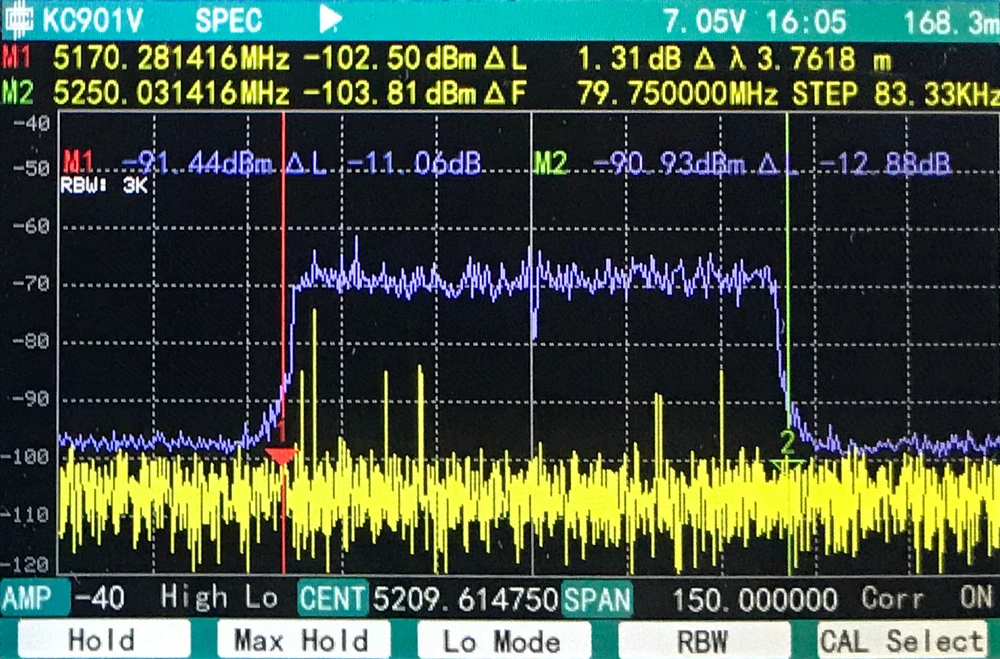
Signal map
To make a signal map we used the AirSurvey software. To read the signal levels correctly, please pay attention to the color legend at the bottom of the picture. Access point location is marked with an appropriate icon.Speed test
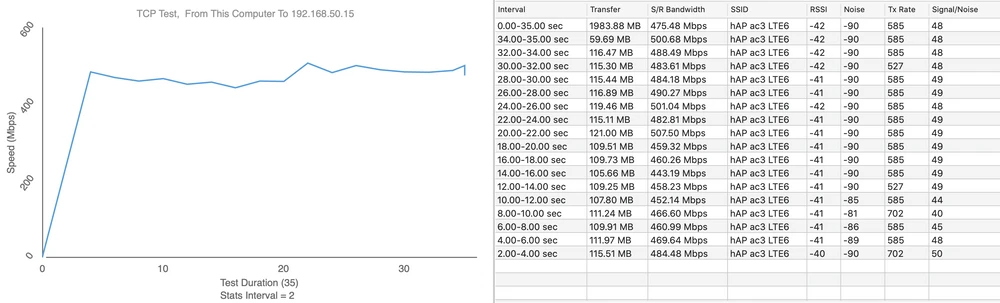
We performed speed tests with WiFiPerf, software and the speed test server was iperf3 software.- measuring point No. 1
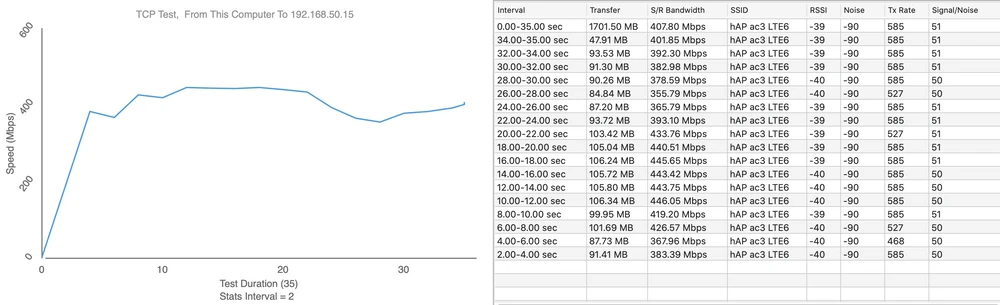
- measuring point No. 2
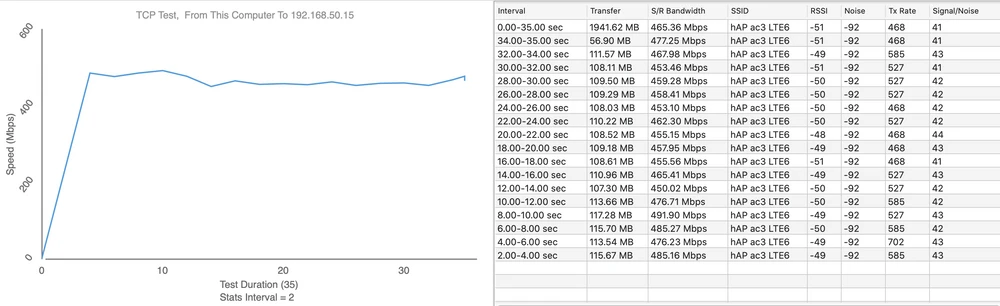
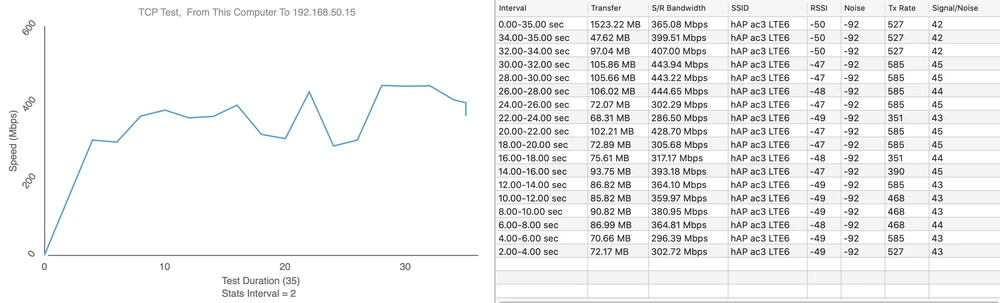
- measuring point No. 3
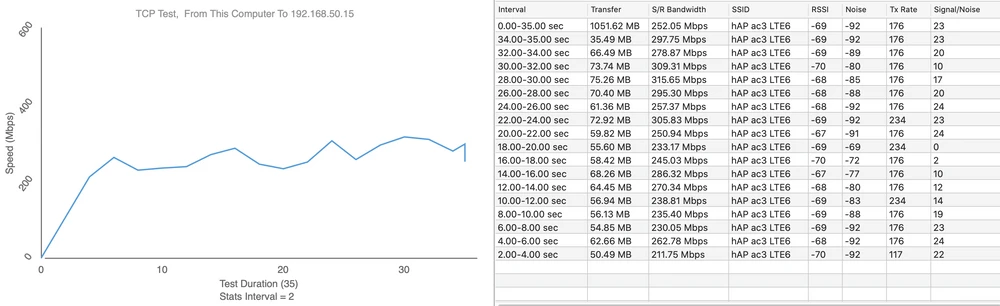
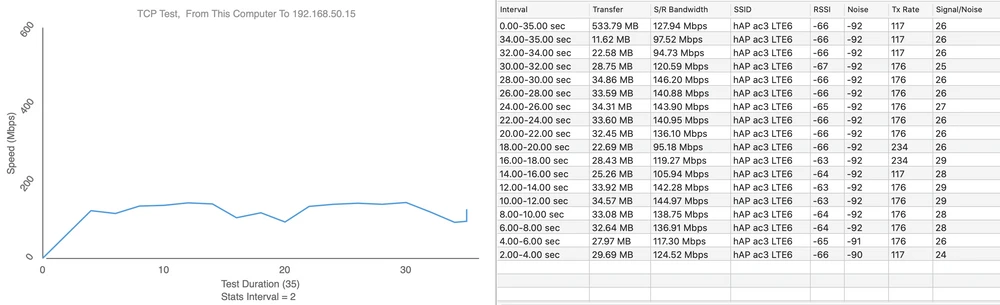
- measuring point No. 4
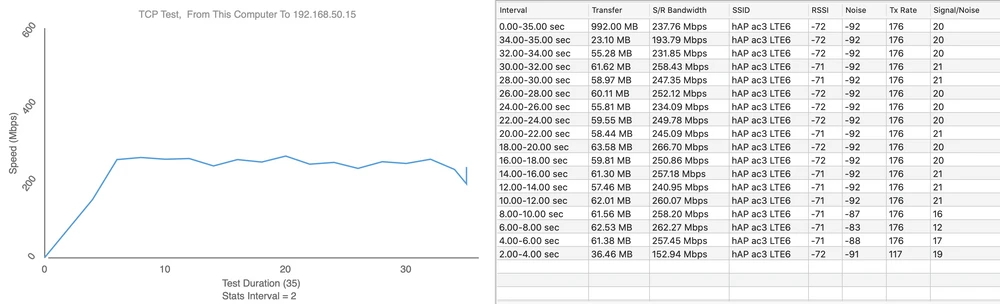
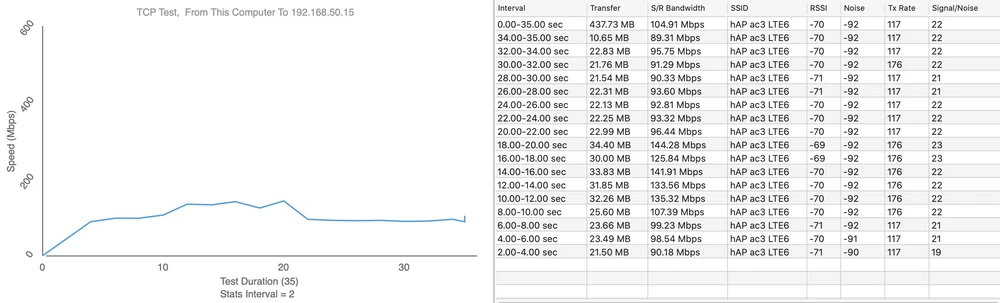
- measuring point No. 5
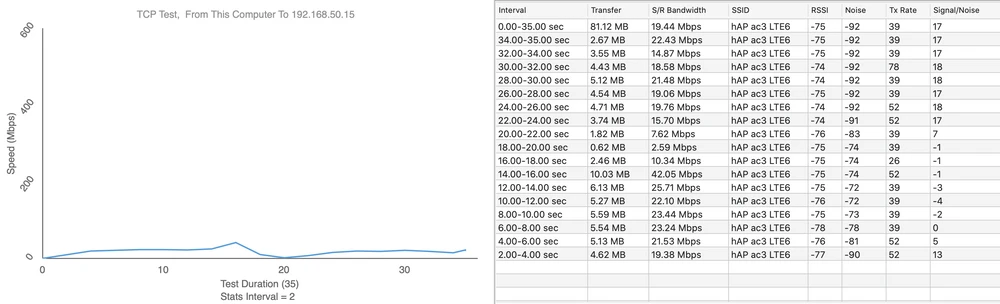
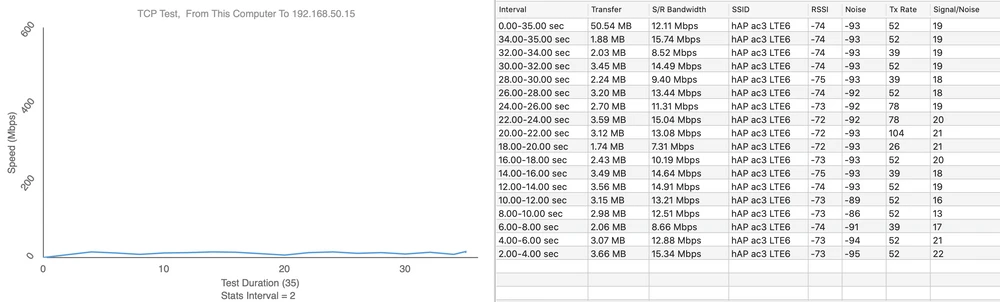
- measuring point No. 6
Test summary MicroTik hAP ac3 LTE6
In terms of performance MikroTik hAP ac3 LTE6 has handled all the basic routing tasks very well. The best results were obtained in a vertical and sideways position towards the transmitter. The only thing worth noting is the problem with 2xCA. This mode worked very unevenly, sometimes it started up and speeds reached 70Mbps, and sometimes the mode turned off and speeds reached max 35Mbps.
All in all, with 5 Gigabit Ethernet ports, 256 RAM and a quad-core processor the hAP ac3 LTE set is able to satisfy even the largest and most demanding households. The MicroTik hAP ac3 LTE6 housing allows vertical or horizontal mounting, and you will also find a wall mount kit. However, in our opinion, using it at home should be considered by specialists who already have experience with such equipment, or users who have to solve complex problems with processing network traffic.
- LTE cat. 6
- LTE works in the 2.4 and 5 GHz bands simultaneously
- Double polarity (2x2 MIMO / dual chain) in both bands
- 5 Gigabit Ethernet ports
- USB port, microSIM slot, miniPCIe slot
- Powerful IPQ-4019 processor (4 cores of 716 MHz)
- 256 MB RAM
- RouterOS system with a Level 4 license