Introduction
Today we take a look at
Cambium Networks, which has recently become famous on the market due to
Elevate technology, and namely their
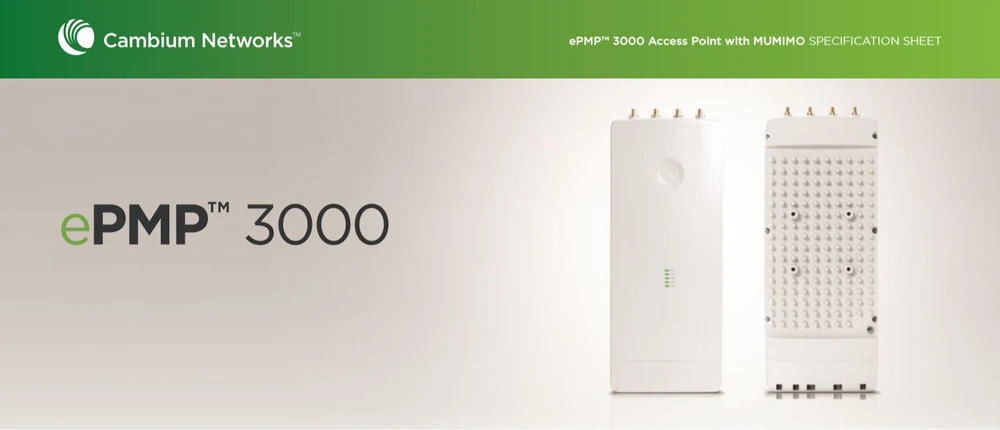
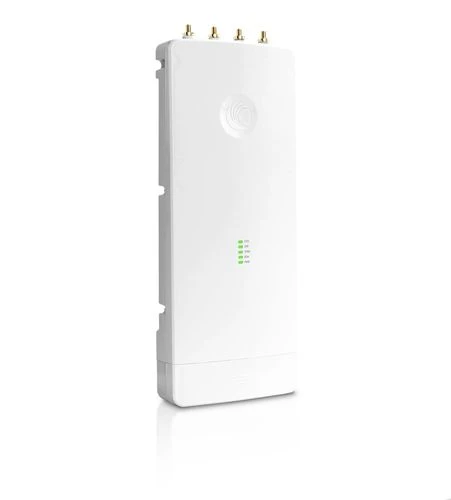
ePMP3000 base station. The model we received for testing had all the additional bells and whistles, a base supporting
4x4 Multi User MIMO (MUMIMO) technology. The purpose of our test is to check if
MUMIMO technology, which has been promoted by Cambium for several years now, actually allows to squeeze out more
from the AC wave 2 technology than the competitors managed to do using AC wave 1 solutions.
Cambium ePMP3000
ePMP3000 is an access point made with the 802.11 AC wave 2 technology, which
can handle 802.11ac wave 2 and 802.11n client terminals simultaneously. This allows for a smooth, gradual network upgrade from
N technology (
Cambium,
UBNT,
Mikrotik) to AC wave 2 technology with support for
MUMIMO. Our testing happily coincided with the appearance of the first low-budget AC wave 2 client unit in Cambium's offer, namely
Force300-13L, which we will of course use for our testing.
Unboxing
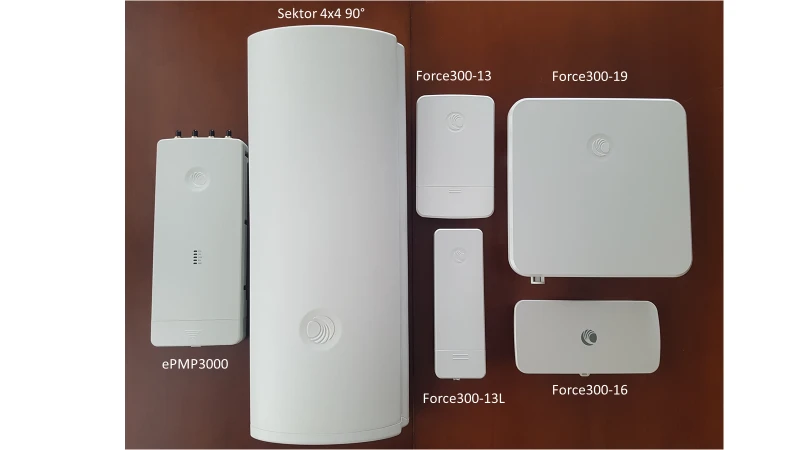
Everyone has their own opinion on the matter, but we think the competition does a little better in making their devices aesthetic. But the truth is that this is not a beauty contest, but a contest of durability and performance. The equipment is solidly packed and makes a very positive impression.The three-year manufacturer's guarantee confirms our belief that this is a good investment. Our special attention is drawn to the sector antenna, which weighs more than 7kg with its mounting brackets! Each box contains a power supply unit, power cord and mounting brackets.
Testing centre
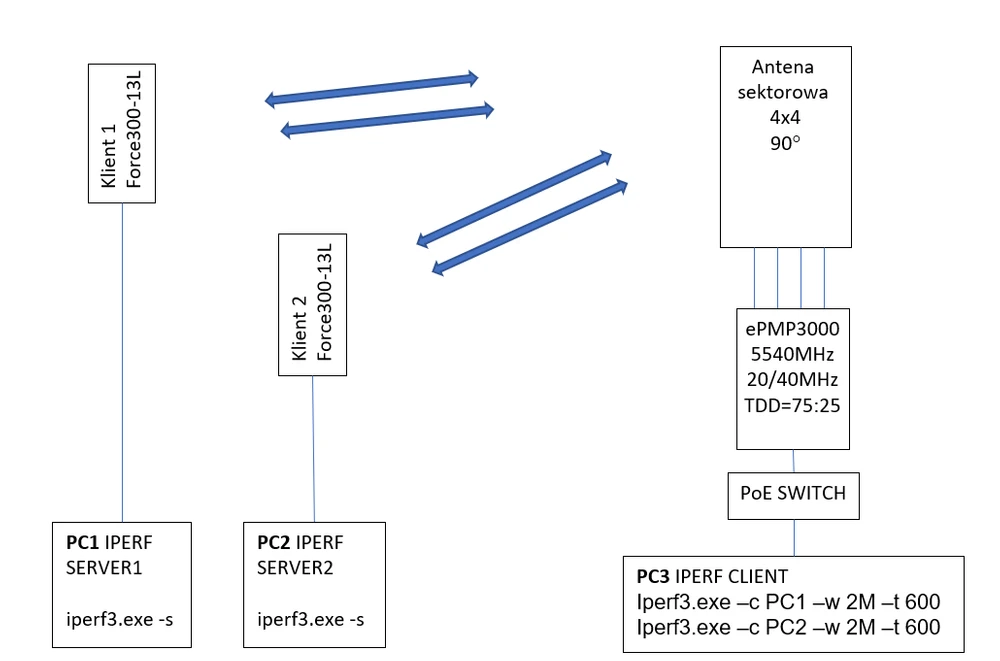
We simulated TCP download traffic using iperf 3.1.3 using 3 independent computers (3 laptops with Windows 10). We set up the hardware in a rather tight room, which proved to be a great challenge for MUMIMO. Just as MIMO technology can manage signal reflections, for MUMIMO reflections are a big challenge.
The client terminal has problems with reporting its base station position because the reflected signals come from many sides and the
sounding mechanism is disturbed.
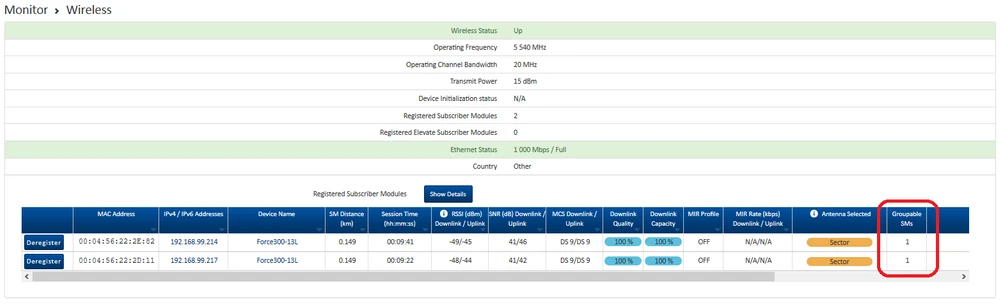
After a long trial, we managed to find such positions for the client endings that the MUMIMO mode would be enabled. According to the manufacturer's assurances, there is no problem with sounding for outdoor installations, as there are no multiple reflections from 4 base station transmitting antennas.In the list of client devices connected to the base station you can see which devices can use MUMIMO technology, by checking if this value is greater than zero in the Groupable SMs column.
Cambium ePMP3000 performance tests
We performed our tests for the 20MHz and 40MHz channels. We dropped the 80MHz test, because we don't think it's logical to use this channel size for point-multipoint applications in most locations (although of course we will find exceptions). We set the hardware in TDD 75:25 with GPS synchronization.The 75:25 division means that 75% of base station time is reserved for transmission in the "to client" direction - i.e. downloading client data, and 25% of base time is reserved for transmission "from client" - i.e. sending client data (upload).
Network diagram
Performance tests - 20MHz
We performed the test as described below:
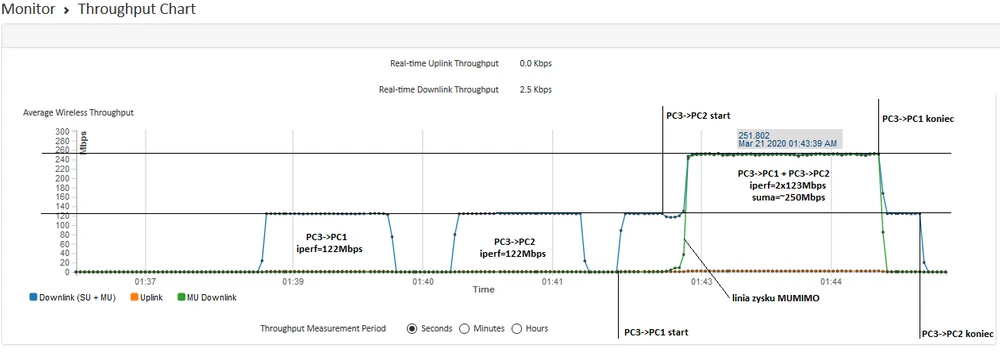
- Transmission only from PC3 to PC1 (60 seconds, one TCP session) = ~125Mbps (iperf: 122Mbps)
- Transmission only from PC3 to PC2 (60 seconds, one TCP session) = ~125Mbps (iperf: 122Mbps)
- Transmission only from PC3 to PC1 and to PC2 (120 seconds, one session to each PC = ~252Mbps (iperf: 2x123Mbps)
And here is the test result read from the ePMP3000 base station throughput monitor:
Performance tests - 40MHz
Same as for 20MHz, we ran a test for 40MHz:
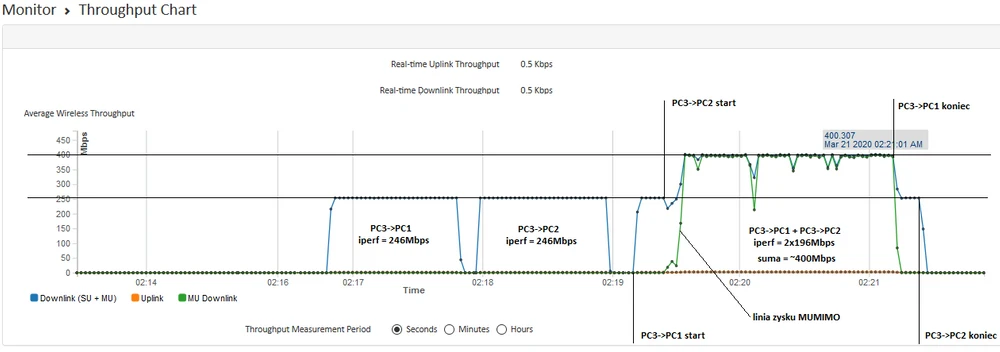
- Transmission only from PC3 to PC1 (60 seconds, one TCP session) = ~250Mbps (iperf: 246Mbps)
- Transmission only from PC3 to PC2 (60 seconds, one TCP session) = ~250Mbps (iperf: 246Mbps)
- Transmission only from PC3 to PC2 (60 seconds, one TCP session) = ~250Mbps (iperf: 246Mbps)
- Transmission only from PC3 to PC1 and to PC2 (120 seconds, one session to each PC = ~400Mbps (iperf: 2x196Mbps)
And the test result read from the ePMP3000 base station throughput monitor:
Conclusions
It turns out that the MUMIMO technology promoted by Cambium really works! I have to admit that it's an unusual sight to see how joining another client to the station doubles its efficiency instead of lowering it! Our tests proved 100% bandwidth gain (full doubling!) for 20MHz channel. For the 40MHz channel it was only a sixty percent increase.We asked the local
Cambium representative for a comment on this issue and found out that further base station code optimization will be carried out in the direction of gradually increasing MUMIMO profit for channels above 20MHz. It is important to understand that
MUMIMO is not double speed for the client but double base capacity, and this translates into package sizes offered to clients. The increase in capacity with the MUMIMO has additional advantages that cannot be ignored.Firstly,
capacity gain occurs without increasing the channel, and secondly, it does not require increasing the signal quality as is the case with systems with higher modulations. This means that if today we reach 100-150Mbps from the base, then by using
MUMIMO supporting terminals we will get 200-300Mbps without changing the channel.We did not focus on testing the direction from the client, but with our test setting
TDD=75:25, we got ~35Mbps for the 20MHz channel and ~75Mbps for the 40MHz channel.Spectral efficiency of a single sector working in a 20MHz channel, with AC wave 2 terminals, is therefore at MUMIMO: (250+35)Mbps / 20MHz = 14.25 bit/s/Hz, which when using GPS synchronization and using
the same frequency in opposite directions of a four-sector base station gives us the result
28.5 bit/s/Hz!.
We also invite you to our
FORUM, where you can exchange your thoughts on MU-MIMOs and
Cambium Networks equipment.